Borosilicate vs Quartz Labware — Which Glass Does Your Lab Actually Need?
Every laboratory budget conversation around glassware eventually hits the same question: should we buy borosilicate or quartz? The price difference is 5–10×, and the wrong choice either wastes money or compromises results. Yet most procurement teams make this decision based on habit — not on what their specific applications actually demand.
This guide breaks down exactly when borosilicate 3.3 glass is the correct specification, when only fused quartz will work, and how to match the right material to every common lab application — from routine volumetric analysis to high-temperature ashing and trace metal determination.
What Is Borosilicate 3.3 Glass and Why Is It the Lab Standard?
Borosilicate 3.3 glass (conforming to ASTM E438 Type I, Class A) contains approximately 80% silica and 13% boron trioxide. This composition gives it three properties that make it the default material for laboratory glassware worldwide:
- Thermal shock resistance — withstands sudden temperature changes up to 180°C without cracking (soda-lime glass fails at ~50°C differential)
- Chemical durability — resists most acids, alkalis, and organic solvents at concentrations used in routine lab work
- Dimensional stability — maintains calibration accuracy in volumetric glassware across normal temperature ranges
Common Borosilicate Labware and Their Applications
| Glassware Type | Key Specifications | Primary Application |
|---|---|---|
| Low form beakers (with spout) | 50 mL – 5000 mL | General heating, mixing, dissolution |
| Tall form beakers | Graduated, narrow profile | Titrations, precipitation reactions |
| Conical (Phillips) beakers | Tapered walls | Digestion, evaporation with reduced splashing |
| Erlenmeyer (conical) flasks | Wide base, narrow neck | Swirling reactions, culture media prep |
| Round bottom flasks (1–4 neck) | Ground joints, various neck configs | Reflux, distillation, rotary evaporation |
| Volumetric flasks Class A | ASTM / USP / EP certified | Standard preparation, dilution to mark |
| Volumetric flasks (amber) | UV-blocking glass | Light-sensitive standard preparation |
| Kjeldahl flasks | Long neck, round bottom | Nitrogen / protein digestion |
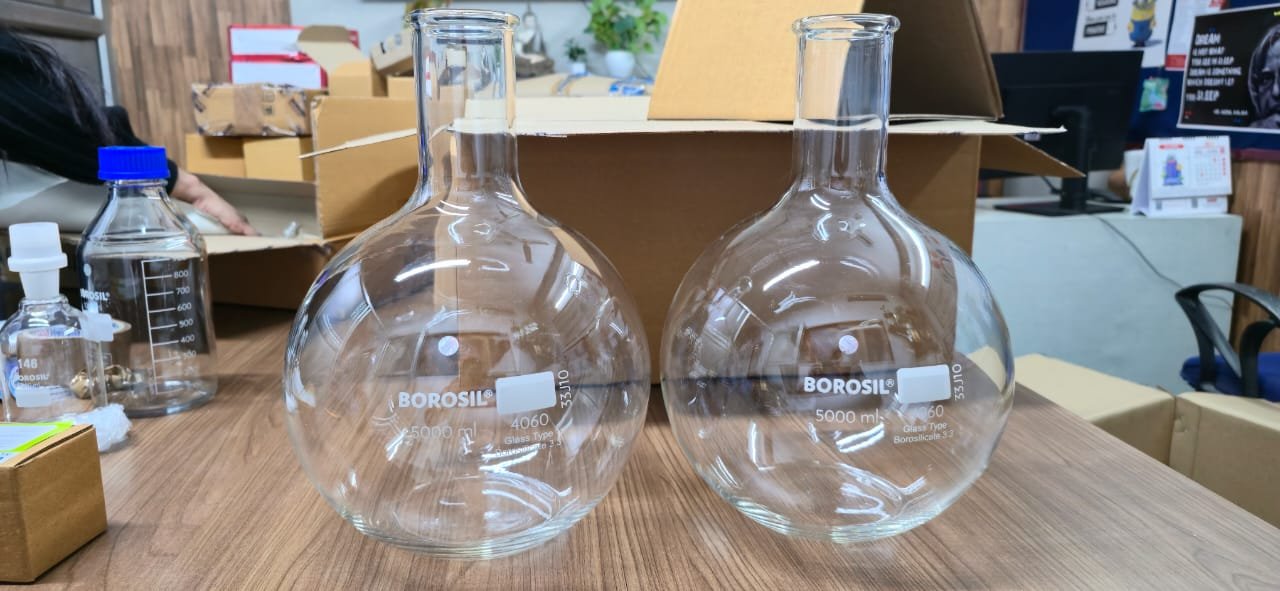
| Flat bottom boiling flasks | Narrow mouth | Simple boiling, solvent recovery |
Bottom line: If your work stays below 500°C, doesn't involve hydrofluoric acid, and doesn't require UV transparency below 300 nm — borosilicate 3.3 from a certified manufacturer like Borosil is the right choice. It covers approximately 90% of routine laboratory workflows.
When Does Your Lab Need Quartz Labware?
Fused quartz (SiO₂ purity >99.5%) operates where borosilicate reaches its physical limits. The key differences:
- Temperature ceiling: Quartz handles continuous use up to 1100°C vs 500°C for borosilicate
- UV transmission: Quartz transmits UV light down to 170 nm; borosilicate blocks everything below ~300 nm
- HF resistance: Quartz resists hydrofluoric acid; borosilicate dissolves in it
- Trace metal contamination: Quartz introduces negligible metal ions; borosilicate leaches sodium, boron, and silicon
When Quartz Is Non-Negotiable
- Quartz crucibles — Gravimetric analysis, LOI (Loss on Ignition) testing, and ashing in muffle furnaces above 900°C. Standard requirement for cement labs, metallurgy, and environmental testing running IS/ASTM ignition methods.
- Quartz combustion boats (with handle) — Elemental analysis in tube furnaces for carbon, sulfur, and nitrogen determination in steel, coal, and petroleum. No borosilicate alternative exists.
- Quartz beakers (low form) — HF digestion of silicate minerals and geological samples. The only option when your dissolution protocol specifies hydrofluoric acid.
- Quartz petri dishes — UV exposure studies, photochemistry, and semiconductor-adjacent material testing where UV transparency below 300 nm is critical.
- Quartz volumetric flasks and conical flasks — Preparing calibration standards for ICP-OES, ICP-MS, and AAS at ppb/ppt levels where glass leaching would introduce systematic contamination.
- Quartz funnels (75mm) — High-temperature filtration and aggressive chemical transfers involving HF or molten samples.
Choosing the Right Distillation Apparatus — Condenser and System Selection
Distillation is where glassware selection directly impacts yield, purity, and safety. The choice of condenser and distillation system depends on what you're distilling, your target purity, and whether you need continuous or batch operation.
Condensers — Matched to Application
- Liebig Condenser — Straight-tube, water-jacketed. The workhorse for simple distillation of single-component solvents. Ideal for routine solvent recovery in pharma QC and academic chemistry labs.
- Graham Condenser (I/C Joint) — Coiled inner tube delivers higher surface area. Use for reflux setups requiring extended condensation — organic synthesis, reaction monitoring, multi-step pharma R&D.
- Allihn (Air) Condenser — Bulbed design for high-efficiency reflux with volatile solvents at or near boiling point. Standard in synthetic chemistry.
- Friedrichs Condenser (Drip Tip) — Finger-type design for low-boiling-point solvents. Compact and efficient for micro-distillation and essential oil determination.
Complete Distillation Systems
- Kjeldahl Distillation System — Purpose-built for nitrogen/protein estimation per IS 1479 and AOAC methods. Critical for food quality, dairy testing, and agricultural research.
- Dean Stark Distilling Apparatus — Specifically designed for azeotropic water determination in petrochemical, paint, and polymer labs. Indispensable for moisture content analysis in oils and resins.
- Water Distillation Units (single, double, all-quartz) — For producing distilled water in-house. Single-distillation for general lab use; double or all-quartz for pharma-grade water.
- Essential Oil Determination Apparatus — Clevenger-type setup for steam distillation in phytochemistry, ayurvedic research, and herbal extract development.
Critical selection detail: Ground joint sizes and I/C joint configurations must match across your flask, condenser, and receiver. Mismatched joints cause vapor leaks, yield loss, and safety hazards. Always specify joint sizes when ordering distillation components.
What to Look for in a Laboratory Glassware Supplier in India
Sourcing lab glassware from generic online catalogs introduces three risks: receiving uncertified glass that doesn't meet ASTM/ISO specifications, getting mismatched joint sizes across components, and having zero technical support when you need application guidance.
A reliable glassware supplier should offer:
- Authorized brand partnerships — Genuine Borosil borosilicate with batch traceability, not unbranded alternatives
- Full documentation — Certificate of Analysis (COA) and material specifications included with every order at no extra cost
- Technical consultation — Grade and material selection guidance before purchase, not just a product catalog
- Complete range — Beakers, flasks, condensers, distillation systems, AND quartz labware from a single supplier to reduce vendor fragmentation
- Bulk and institutional pricing — Competitive rates for schools, colleges, and procurement departments placing volume orders
- Fast turnaround — Quote within 2 hours, same-day dispatch for in-stock items
Scientific Edge is an authorized Borosil channel partner supplying the complete borosilicate and quartz glassware range — from low form beakers to Kjeldahl distillation systems to quartz combustion boats. Every order ships with COA and material documentation. Technical consultation on material selection, joint size matching, and system configuration is included at no charge. Serving labs across Delhi NCR, Noida, Ghaziabad, Meerut, and pan-India with express delivery options.
Frequently Asked Questions
Can I use borosilicate glassware in a muffle furnace?
No. Borosilicate 3.3 has a maximum service temperature of approximately 500°C. Muffle furnaces operate at 900–1100°C for ashing and LOI testing. Use quartz crucibles or quartz combustion boats for muffle furnace applications.
Why are quartz volumetric flasks recommended for trace metal analysis?
Borosilicate glass leaches sodium, boron, and silicon ions at ppb levels during prolonged contact with acidic standard solutions. For ICP-OES, ICP-MS, and AAS calibration standards at trace concentrations, quartz volumetric flasks eliminate this contamination source.
What is the difference between a Liebig and Graham condenser?
A Liebig condenser has a straight inner tube — efficient for simple distillation. A Graham condenser has a coiled inner tube providing significantly more surface area — better for reflux setups where extended condensation time improves yield. Choose based on whether you're distilling or refluxing.
Which distillation system is used for protein estimation in food labs?
The Kjeldahl distillation system is the standard for nitrogen and protein estimation following IS 1479 and AOAC methods. It's purpose-built for acid digestion followed by steam distillation and titration.
Does Scientific Edge supply both borosilicate and quartz glassware?
Yes. Scientific Edge is an authorized Borosil channel partner and supplies the full borosilicate range (beakers, flasks, condensers, distillation systems) plus specialty quartz labware (crucibles, combustion boats, beakers, petri dishes, volumetric flasks, conical flasks, and funnels) with PAN-India delivery.
Need Certified Lab Glassware with COA?
Call Scientific Edge for material selection guidance matched to your specific application. Or WhatsApp your glassware requirement list — we reply with itemized pricing and stock availability within 2 hours.