Ammonium Perchlorate Supplier in India: Grades, Specifications and Sourcing Guide for Defense, Aerospace and Industrial Buyers
Finding a reliable ammonium perchlorate supplier in India requires understanding grade specifications, particle-size requirements, regulatory compliance, and documentation needs. This guide covers everything Indian defense, aerospace, and industrial buyers need to know — from propellant-grade specifications to PESO licensing requirements — so you can prepare a precise requirement and source the right product for your application.
What Is Ammonium Perchlorate and Why Is It a Critical Industrial Oxidizer?
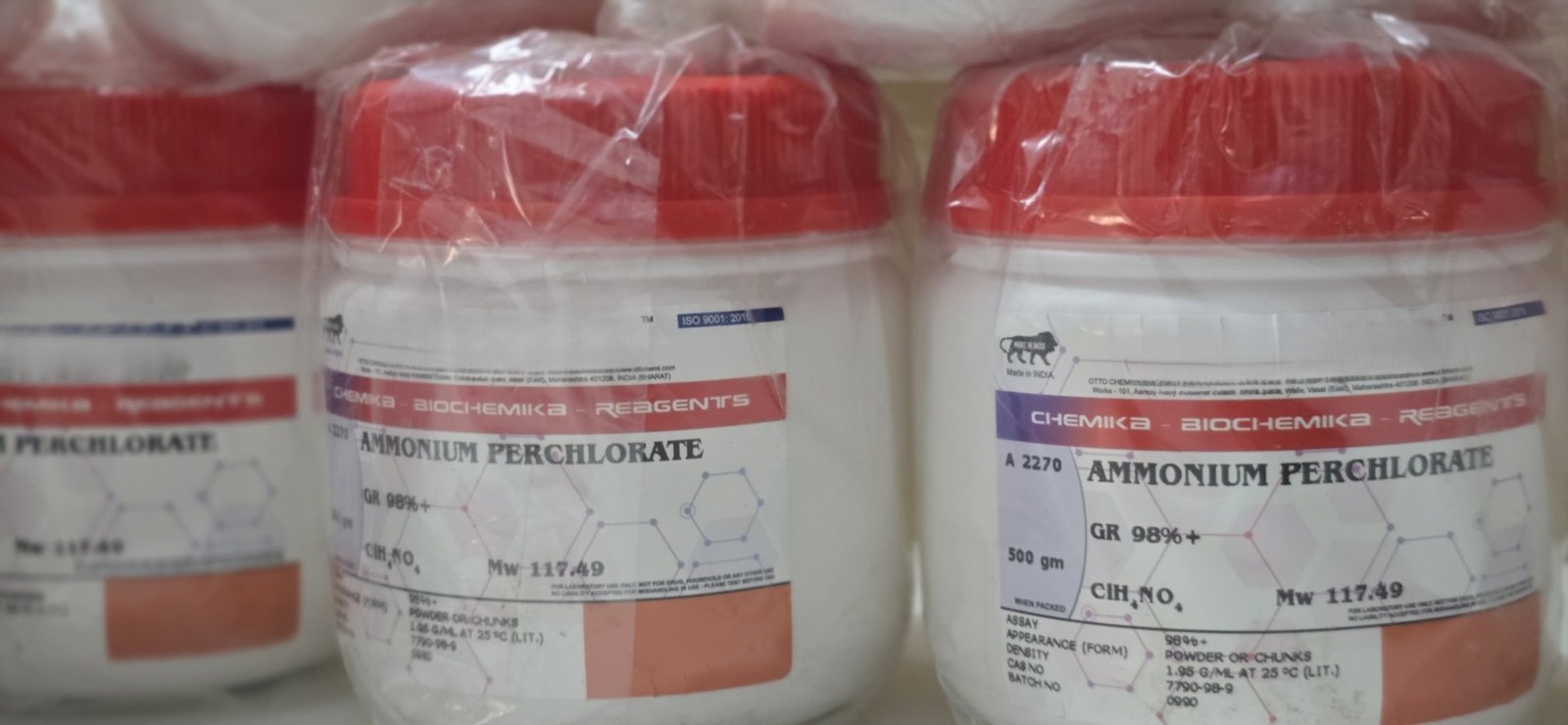
Ammonium perchlorate (NH₄ClO₄, CAS 7790-98-9) is a white crystalline inorganic compound with a molecular weight of 117.49 g/mol. It is the most widely used solid oxidizer in composite propellant formulations worldwide, providing the oxygen necessary for combustion in solid rocket motors.
When combined with a polymeric binder — typically Hydroxyl-Terminated Polybutadiene (HTPB) — and a metallic fuel such as atomized aluminium powder, ammonium perchlorate forms Ammonium Perchlorate Composite Propellant (APCP). This combination delivers high specific impulse, predictable burn characteristics, and long-term storage stability, making it indispensable for both civilian space programmes and military applications.
In India, ammonium perchlorate is classified as a Class 5.1 Oxidizer (UN 1442) under transport regulations and falls within the regulatory oversight of the Petroleum and Explosives Safety Organisation (PESO) under the Explosives Act, 1884 and Explosives Rules, 2008. This means procurement, storage, and handling require specific licenses and documentation — a critical factor in your sourcing decision.
Key Applications of Ammonium Perchlorate in India
Solid Rocket Propellants — ISRO Launch Vehicles
ISRO's Polar Satellite Launch Vehicle (PSLV) and the LVM3 (formerly GSLV Mk III) rely heavily on APCP-based solid rocket boosters. The S200 solid boosters on LVM3, for example, use hundreds of tonnes of composite propellant per launch, with ammonium perchlorate constituting approximately 68–70% of the propellant mass. India's increasing launch frequency — including commercial satellite deployments and deep-space missions — sustains significant institutional demand.
Defense Missile Systems
India's strategic and tactical missile programmes under DRDO extensively use AP-based solid propulsion. Systems including the Agni series (strategic ballistic missiles), Akash (surface-to-air), and Pinaka (multi-barrel rocket launcher) use composite solid propellants. The Atmanirbhar Bharat push for indigenous defense manufacturing has further expanded domestic procurement requirements.
Pyrotechnics, Gas Generators and Safety Systems
Beyond propulsion, ammonium perchlorate serves as an oxidizer in pyrotechnic compositions, aircraft ejection-seat cartridges, automotive airbag inflators, and specialized gas generators. These applications typically require controlled particle-size distributions and high chemical purity to ensure reliable, consistent performance.
Analytical and Research Applications
Defense R&D laboratories (HEMRL, TBRL), academic institutions (IITs, NITs), and private research facilities use analytical-grade and reagent-grade ammonium perchlorate for propellant research, thermal analysis (DSC/TGA studies), decomposition kinetics studies, and formulation development. AR and GR grades from suppliers like CDH Fine Chemical or Loba Chemie are commonly specified for laboratory work.
Understanding Ammonium Perchlorate Grades and Particle Sizes
Not all ammonium perchlorate is the same. The grade and particle size you specify directly affect your application's performance, safety, and compliance requirements.
Specification Comparison: Propellant Grade vs. Analytical Grade
| Parameter | Propellant Grade (Mil-Spec) | Analytical / Reagent Grade (AR/GR) | Technical Grade |
|---|---|---|---|
| Assay (purity) | ≥ 99.0–99.7% | ≥ 98.0–99.0% | ≥ 98.0% |
| Total moisture | ≤ 0.08% | ≤ 0.10% | ≤ 0.15% |
| Surface moisture | ≤ 0.015% | Not typically specified | Not typically specified |
| Chlorate (as NH₄ClO₃) | ≤ 0.015% | ≤ 0.02% | ≤ 0.05% |
| Chloride (as NH₄Cl) | ≤ 0.05% | ≤ 0.005–0.01% | ≤ 0.10% |
| Water insolubles | ≤ 0.01% | ≤ 0.01% | ≤ 0.05% |
| Iron (as Fe₂O₃) | ≤ 0.0004–0.003% | ≤ 0.001% | Not typically specified |
| pH | 4.0–6.0 | 4.0–6.0 | 4.0–6.0 |
| Particle size | Specified per D₅₀ (200, 400 µm, etc.) | Fine powder (unspecified) | Variable |
| Primary applications | Solid propellants, defense | Laboratory analysis, R&D | Pyrotechnics, industrial |
| Documentation | COA, batch test report, Mil-Spec compliance | COA, SDS | COA, SDS |
Sources: Manufacturer datasheets (ammonium-perchlorate.com, CRS Chemicals), military specification references MIL-A-192B
Particle-Size Grades for Propellant Applications
| Grade | Nominal D₅₀ | Typical Morphology | Role in Propellant |
|---|---|---|---|
| Coarse (400 µm) | 400 ± 25 microns | Spherical, regular crystals | Primary filler for maximum solids loading; controls viscosity during mixing |
| Medium (200 µm) | 200 ± 25 microns | Granular, rounded | Intermediate structural grain; optimizes packing density |
| Fine (50–90 µm) | 50–90 microns | Angular to sub-rounded | Fills interstitial voids; influences burn rate |
| Ultra-fine (<10 µm) | 2–10 microns | Milled/ground | Fine-tunes burn rate; increases sensitivity — handle with extreme caution |
How Particle Size Affects Propellant Performance — A Buyer's Selection Guide
In composite solid propellants, ammonium perchlorate typically constitutes 60–72% of the total formulation by mass. The particle-size distribution (PSD) directly controls three critical performance parameters:
1. Solids Loading and Density: Bimodal (coarse + fine) or trimodal (coarse + medium + fine) AP distributions allow higher solids loading — up to 86% by mass in some formulations. Higher solids loading increases propellant density and energy output. The 400 µm coarse fraction forms the structural backbone, while finer fractions fill the voids.
2. Burn Rate: Smaller AP particles increase the specific surface area available for decomposition, accelerating the burn rate. If your application demands a faster burn (shorter burn time, higher thrust), you need a higher proportion of fine particles. For sustained, lower-thrust burns, coarse-dominant formulations are preferred.
3. Processability: Excessively fine AP increases the propellant slurry viscosity, making mixing and casting difficult. The coarse fraction (400 µm) manages viscosity, allowing the propellant to flow into complex motor-case geometries.
Common Selection Mistakes
| Mistake | Consequence | Prevention |
|---|---|---|
| Specifying particle size without D₅₀ and distribution tolerance | Inconsistent burn rate between batches | Always specify D₅₀ ± tolerance and sieve analysis requirements |
| Using generic "fine powder" without defined micron range | Potential sensitivity hazard, uncontrolled burn rate | Define exact micron range (e.g., 50–90 µm) with upper and lower bounds |
| Mixing particle grades from different manufacturers without testing | Morphology differences can alter packing density | Qualify each batch through formulation trials before scaling |
| Ignoring moisture limits in humid storage conditions | Caking, reduced purity, failed batch tests | Enforce storage controls per SDS; verify COA moisture values on receipt |
Regulatory Compliance for Buying Ammonium Perchlorate in India
Sourcing ammonium perchlorate in India is not a simple purchase order. The regulatory framework is significant, and non-compliance carries serious legal and safety consequences.
PESO Licensing and the Explosives Act 1884
The Petroleum and Explosives Safety Organisation (PESO), under the DPIIT (Ministry of Commerce and Industry), oversees the manufacture, storage, transport, and sale of explosive and oxidizing materials in India. Under the Explosives Act, 1884 and the Explosives Rules, 2008:
- Manufacturing facilities handling AP must hold DPIIT and PESO licenses with approved site-layout plans, HAZOP studies, and fire-safety NOCs.
- End-users procuring bulk industrial/propellant-grade AP must demonstrate valid end-use documentation, licensed storage facilities, and approved technical know-how.
- Research institutions using smaller laboratory quantities (AR/GR grade) may have different requirements depending on quantity, storage, and institutional policies.
End-Use Documentation and NOC Requirements
Buyers should be prepared to provide:
- Valid explosive storage license or institutional authorization
- End-use certificate specifying application (propellant R&D, pyrotechnic testing, etc.)
- NOC from Chief Fire Officer (for storage facilities)
- Environmental consents from the State Pollution Control Board (SPCB)
- Company/institutional registration details and authorized signatory information
Transport Classification
| Parameter | Specification |
|---|---|
| UN Number | UN 1442 |
| Hazard Class | 5.1 (Oxidizer) |
| Packing Group | II |
| Shipping Name | Ammonium perchlorate |
| Special provisions | Particle size and moisture state may affect classification; verify with transporter |
Storage and Safety Requirements
- Store in cool, dry, well-ventilated areas away from incompatible materials (organic compounds, metallic powders, reducing agents, sulfur, phosphorus).
- All electrical installations in storage zones must be flame-proof/explosion-proof certified.
- Maintain dedicated water deluge systems for fire suppression.
- Never use combustible absorbents (sawdust, cloth) for spill cleanup.
- Personnel must wear antistatic clothing and appropriate respiratory protection when handling dry powder.
How to Source Ammonium Perchlorate — RFQ Checklist for Indian Buyers
Preparing a complete Request for Quotation (RFQ) significantly reduces back-and-forth and helps your supplier confirm suitability, pricing, documentation, and delivery terms accurately.
RFQ Template — Ammonium Perchlorate
| RFQ Field | Information to Provide |
|---|---|
| Product | Ammonium perchlorate (NH₄ClO₄) |
| Grade required | Propellant grade / Analytical (AR/GR) grade / Technical grade |
| Purity requirement | Minimum assay (e.g., ≥ 99.0%) |
| Particle size | D₅₀ specification with tolerance (e.g., 400 ± 25 µm) and sieve analysis requirements |
| Quantity | Total quantity in kg, pack-size preference (e.g., 25 kg HDPE drums), and repeat frequency |
| Preferred brand/manufacturer | If any (e.g., Pandian Chemicals, CDH, or open to alternatives) |
| Documentation required | COA per batch, SDS, Mil-Spec compliance certificate, PESO documentation |
| End-use application | Propellant formulation / R&D / Pyrotechnics / Other |
| Delivery location | City, state, and pincode |
| Licensing status | Valid PESO/explosive-storage license number (for propellant/bulk quantities) |
| Procurement context | Government/PSU tender, private R&D project, institutional purchase, vendor registration |
📞 Ready to discuss your ammonium perchlorate requirement?
Share your grade, particle-size specification, quantity, and delivery location with ScientificEdge. We will confirm suitable sourcing options, documentation availability, pricing, and lead time for your specific requirement.
Call: +91-72909 39259 | WhatsApp: Send your requirement | Email: sales@scientificedge.co.in
Why ScientificEdge for Ammonium Perchlorate Sourcing in India
ScientificEdge is a Delhi NCR-based B2B supplier and sourcing partner supporting laboratory, industrial, defense R&D, and institutional chemical requirements across India.
For ammonium perchlorate sourcing, ScientificEdge offers:
- Multi-brand sourcing capability: Access to analytical-grade chemicals from brands like CDH, Loba Chemie, SRL, and Qualigens for laboratory and R&D applications. Propellant-grade sourcing is evaluated per enquiry based on grade, quantity, end-use documentation, and supply-chain feasibility.
- Specification-led selection support: Assistance in matching your application requirements — particle size, purity, morphology, and documentation needs — to appropriate product options.
- Documentation coordination: COA, SDS, batch test reports, and compliance documentation coordinated for each confirmed order, subject to manufacturer and product availability.
- Pan-India supply coordination: Dispatch from Delhi NCR with logistics evaluated for any Indian delivery destination. Specific delivery timelines, transport compliance, and hazmat handling confirmed per order.
- B2B and institutional procurement support: Experience supporting defense R&D labs, government institutions, pharmaceutical QC laboratories, and private-sector R&D projects.
ScientificEdge does not manufacture ammonium perchlorate. Suitability, stock availability, documentation, pricing, and lead times are confirmed for each enquiry.
📞 Contact ScientificEdge to discuss your ammonium perchlorate requirement and receive a quotation tailored to your grade, quantity, and application.
Frequently Asked Questions
1. What is ammonium perchlorate used for?
Ammonium perchlorate (NH₄ClO₄) is primarily used as a solid oxidizer in composite rocket propellants (APCP) for space launch vehicles and military missiles. In India, ISRO and DRDO are the largest institutional consumers. It is also used in pyrotechnic compositions, aircraft ejection seats, automotive airbag inflators, gas generators, and as a laboratory reagent in analytical chemistry and propellant research.
2. What is the CAS number and UN number for ammonium perchlorate?
The CAS Registry Number is 7790-98-9. The UN Number for transport is UN 1442, classified as Hazard Class 5.1 (Oxidizer), Packing Group II. These identifiers are essential for regulatory documentation, transport permits, and procurement paperwork.
3. What particle sizes of ammonium perchlorate are available for propellant applications?
Propellant-grade AP is typically available in coarse (400 ± 25 µm), medium (200 ± 25 µm), fine (50–90 µm), and ultra-fine (<10 µm) grades. Most composite propellant formulations use a bimodal or trimodal blend of these sizes to optimize solids loading, burn rate, and processability. Specify the D₅₀ value, tolerance, and sieve analysis requirements in your RFQ.
4. Do I need a license to buy ammonium perchlorate in India?
For bulk propellant-grade or industrial quantities, yes. Procurement falls under the Explosives Act, 1884 and Explosives Rules, 2008, overseen by PESO. You will need a valid explosive-storage license, end-use documentation, and in some cases an NOC from local fire authorities and the State Pollution Control Board. Laboratory quantities of AR/GR grade for research may have different requirements depending on institutional policies and quantities.
5. What is the difference between propellant grade and analytical grade ammonium perchlorate?
Propellant grade has tighter purity (≥ 99.0–99.7%), controlled particle-size distribution (specified D₅₀), lower moisture limits (≤ 0.08%), and comes with Mil-Spec compliance documentation. Analytical/reagent grade prioritizes chemical purity for laboratory accuracy but does not specify particle-size morphology for propellant performance. The two grades serve fundamentally different applications and should not be interchanged.
6. How should ammonium perchlorate be stored safely?
Store in cool, dry, well-ventilated, explosion-proof facilities away from organic materials, metallic powders, reducing agents, and ignition sources. Use anti-static HDPE containers with moisture-barrier liners. Maintain dedicated water deluge fire-suppression systems. Never use combustible absorbents for spill cleanup. All handling personnel must wear antistatic PPE and respiratory protection. Storage must comply with PESO-approved site plans and license conditions.
Source the Right Ammonium Perchlorate Grade for Your Application
Whether you need analytical-grade AP for defense R&D testing or are evaluating propellant-grade sourcing for a composite propellant programme, getting the specification right from the start saves time, cost, and compliance headaches.
Share your requirement with ScientificEdge:Grade, purity & particle-size specification · Quantity & pack-size · End-use application & licensing status · Delivery location & timeline
📞 Call: +91-72909 39259
💬 WhatsApp: Send Your Requirement
📧 sales@scientificedge.co.in
🌐 ScientificEdge Contact Page