What Is a Certificate of Analysis (COA) for Laboratory Chemicals?
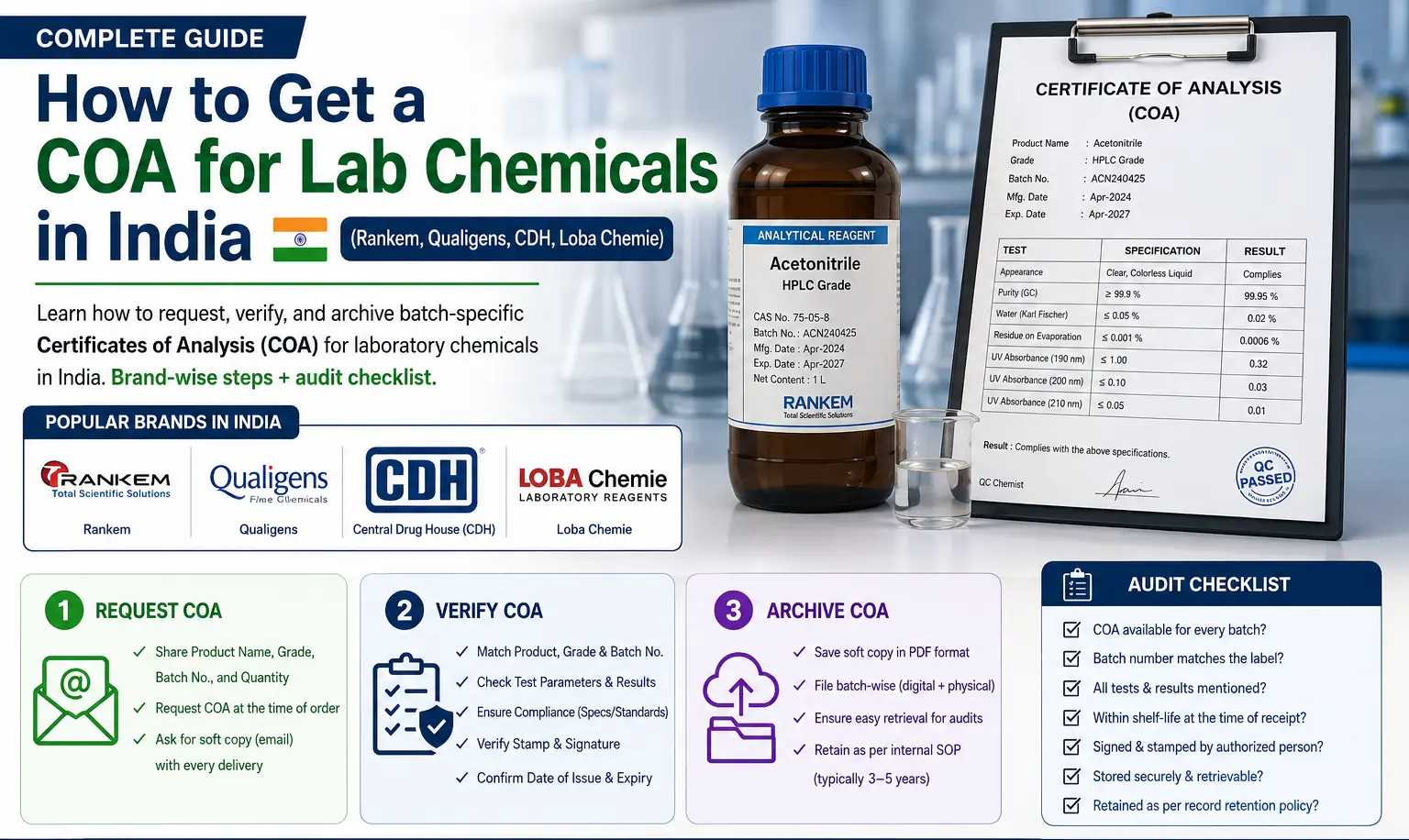
A Certificate of Analysis (COA) is a batch-specific document issued by the chemical manufacturer confirming that a particular lot meets its stated purity, assay, and specification limits through actual analytical testing — typically HPLC, GC, titration, or Karl Fischer methods. For pharmaceutical QC labs operating under NABL (ISO/IEC 17025) or GMP (Schedule M) accreditation, a valid, lot-matched COA is a non-negotiable audit requirement.
Unlike a Safety Data Sheet (SDS), which covers hazard and handling information for a chemical in general, the COA is tied to one specific batch number. That distinction matters because auditors don't ask "do you have a COA for acetonitrile?" — they ask "do you have the COA for batch number ACN-2026-0847 that's currently open on your HPLC bench?"
📊 From our dispatch records: Over 72% of WhatsApp queries from first-time pharma QC buyers mention COA availability as their primary concern — ahead of pricing or delivery timelines. Documentation trust drives vendor decisions in this market more than cost alone.
How to Get COA for Lab Chemicals: 3 Methods That Actually Work in India
Obtaining a batch-specific COA in India involves three main channels: the manufacturer's online portal, direct request through your distributor, or third-party verification. The fastest method depends on the brand and whether you already have the batch/lot number from the bottle label.
Method 1: Download Directly from the Manufacturer's COA Portal
Most major Indian and global lab chemical brands now offer searchable online COA databases. You need two pieces of information from the product label: the product/catalogue code and the batch number (sometimes called lot number).
| Brand | COA Portal Path | Required Fields | Download Time |
|---|---|---|---|
| Loba Chemie | lobachemi.com → Downloads → COA Search | Product Code + Batch No. | Instant (PDF) |
| SRL (Sisco Research Laboratories) | srlchem.com → COA section | Catalogue No. + Batch No. | Instant (PDF) |
| CDH (Central Drug House) | cdhfinechemical.com → COA Download | Product Code + Lot No. | Instant (PDF) |
| HiMedia | himedialabs.com → COA Search | Product Code + Lot No. | Instant (PDF) |
| Rankem (Avantor) | rankem.in → Technical → COA | Product Code + Batch No. | Instant (PDF) |
| Thermo Fisher | thermofisher.com → COA Search | Catalogue No. + Lot No. | Instant (PDF) |
| Merck / MilliporeSigma | sigmaaldrich.com → COA/COQ | Product No. + Lot/Batch No. | Instant (PDF) |
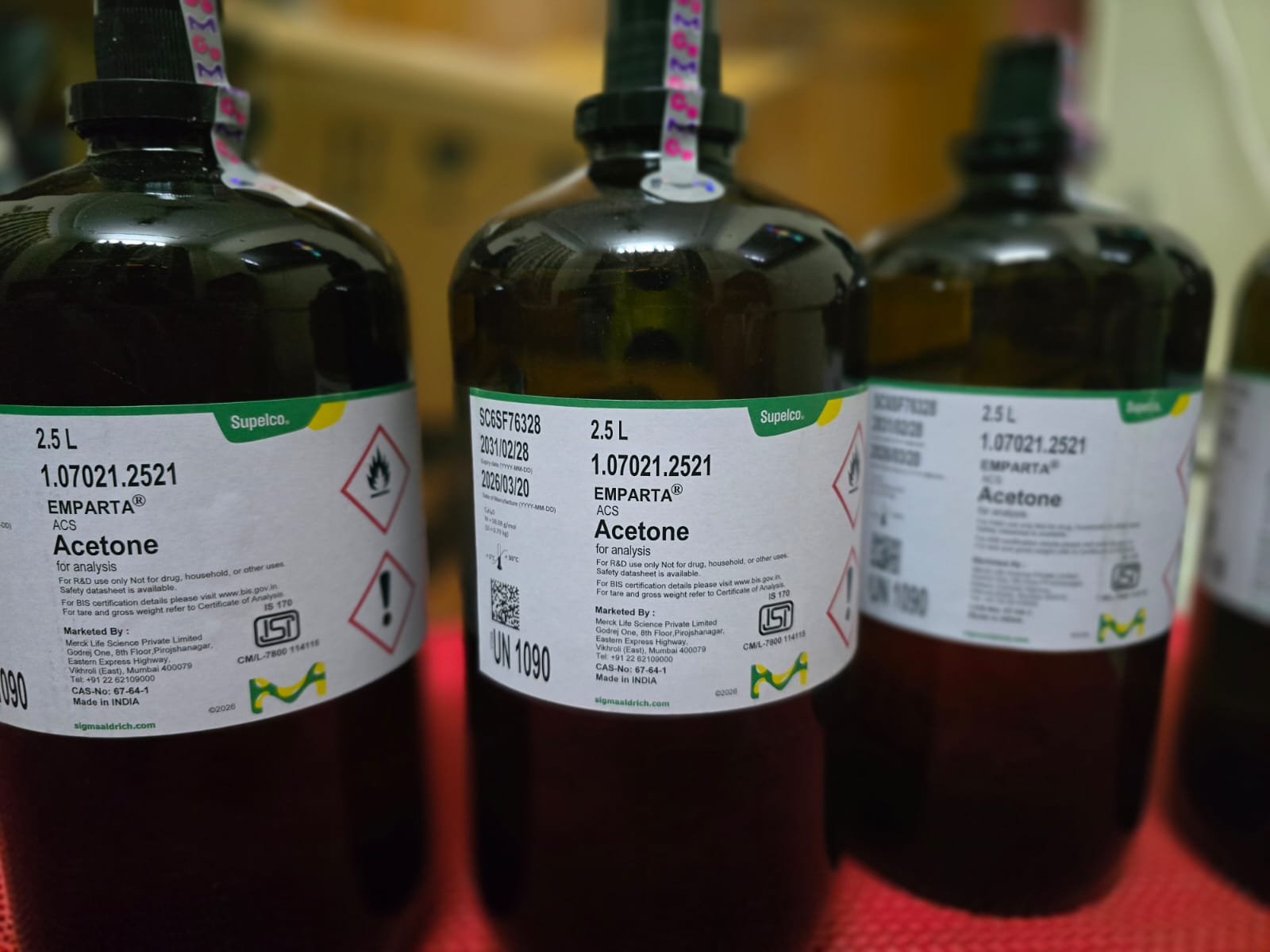
Common failure point: The batch number on the label is printed in small font, often near the barcode. If it's smudged, illegible, or missing, note the manufacturing date and expiry date instead — many portals accept date ranges as secondary search criteria.
Method 2: Request Through Your Authorized Distributor
When the online portal doesn't have your specific batch (common for older lots, discontinued pack sizes, or regional repacking), your distributor should provide the COA within a defined turnaround time.
| Request Channel | Scientific Edge Response | Industry Average |
|---|---|---|
| WhatsApp with batch number | Under 2 hours | 24–72 hours |
| Email with product code + batch | Under 4 hours | 2–5 business days |
| Phone request (verbal) | Same call | "We'll get back to you" |
📊 Operational insight: The single biggest friction point is labs requesting COA without the batch number. Without it, we cross-reference dispatch records by invoice number and delivery date. Including the batch number in your WhatsApp message saves an average of 3 hours.
Method 3: Third-Party Verification
For regulatory submissions, export documentation, or dispute resolution, some labs require a COA from an independent NABL-accredited testing laboratory. Cost: Independent COA testing for a single chemical (purity, moisture, identity) typically ranges from ₹2,000–₹8,000 depending on parameter count and accreditation scope.
How to Read and Verify a COA: The 7-Point Checklist Auditors Actually Use
A valid COA contains more than just a "pass" stamp. Auditors — whether NABL assessors, CDSCO inspectors, or internal QA teams — systematically check seven elements. Missing any one can trigger a non-conformance observation.
The 7-Point COA Verification Checklist:
- Batch/Lot number match — COA batch number matches the physical container label
- Product identity and grade — Chemical name, CAS number, and grade (AR, LR, HPLC, GR, ACS) stated
- Specification limits vs. actual results — Both acceptable range AND tested result shown (not just "Conforms")
- Test methods referenced — Analytical method stated (e.g., "Purity by HPLC: 99.8%")
- Manufacturing and expiry dates — Chemical within stated shelf life
- Authorized signature — Named QC officer's signature or electronic approval with date
- Traceability to standards — Reference to applicable USP, EP, IP, or IS standards
📋 Field note: A diagnostic lab in Bhiwadi failed a NABL surveillance audit because 2 out of 16 COAs were from different batches than what was on the shelf. The auditor physically compared bottle labels against the COA folder. Keep your COA folder organized by product AND batch number, not just product name.
📞 Need Lot-Specific COAs Matched to Your Current Inventory?
WhatsApp your chemical list with batch numbers to Scientific Edge — we verify stock against our documentation system and provide official manufacturer COAs within 2 hours.
COA vs. MSDS vs. SDS vs. Test Report: What's the Difference?
A COA is a batch-specific quality report showing actual test results against specifications, while an SDS is a standardized 16-section safety document covering hazards, handling, and emergency procedures for a chemical regardless of batch. These serve completely different regulatory functions and are not interchangeable.
| Document | What It Tells You | Batch-Specific? | Regulatory Purpose |
|---|---|---|---|
| COA (Certificate of Analysis) | Purity, assay, moisture — actual test results for ONE batch | ✅ Yes | Quality verification, audit compliance |
| SDS / MSDS (Safety Data Sheet) | Hazards, PPE, first aid, storage, disposal | ❌ No | Workplace safety, GHS compliance |
| CoC (Certificate of Conformance) | "Batch conforms" — no actual test data | ✅ Yes | Basic compliance declaration |
| Test Report | Detailed analytical data (chromatograms, spectra) | ✅ Yes | Dispute resolution, R&D characterization |
The 5 COA Questions We Get on WhatsApp Every Week
1. "Batch number nahi mil raha, COA kaise milega?"
Check: (a) the delivery challan or invoice, (b) the outer carton label, (c) your GRN register. If all else fails, share the invoice number and purchase date — we trace the batch from our dispatch records.
2. "Purane batch ka COA chahiye, 2 saal purana hai"
Manufacturer portals typically retain COA data for 3–5 years. Beyond that, expect 5–10 business days via the manufacturer's QA department. Download and archive COAs at receipt time, not audit time.
3. "COA aur MSDS mein kya fark hai?"
COA tells you if your batch is pure enough to use. MSDS tells you how to handle it safely. Auditors need both, but check the COA first.
4. "Distributor ka COA chalega ya manufacturer ka chahiye?"
The COA must originate from the manufacturer. Scientific Edge provides manufacturer-original COAs, not reissued copies.
5. "Ek COA pe kitne bottles cover hoti hain?"
One COA covers one batch number, regardless of bottle count. 10 bottles with the same batch number = one COA. Mixed batches in the same carton = separate COAs needed.
3 COA Documentation Gaps That Trigger Audit Non-Conformances
Gap 1: COA Not Matched to Physical Inventory
Batch numbers on COAs don't match chemicals on the shelf. Chemicals were consumed and restocked, but the COA folder wasn't updated. Fix: Implement an incoming material inspection (IMI) log — verify batch number against COA at receipt, file immediately, and remove COAs for consumed batches.
Gap 2: Certificate of Conformance Used Instead of Full COA
Some suppliers provide a CoC stating "conforms to specifications" without actual test data. Under NABL ISO/IEC 17025 clause 6.6, this is insufficient evidence. Fix: Confirm supplier provides batch-specific COAs with actual analytical test data.
Gap 3: No COA Retention Policy
Retain COAs for a minimum of one accreditation cycle (2–4 years). For GMP/GLP: shelf life plus one year. Fix: Digital archiving indexed by product + batch number is most audit-efficient.
How to Build a COA Documentation System for Your Lab
- At ordering: Confirm supplier provides batch-specific COA on or before delivery
- At receipt (IMI): Verify batch number on bottle label matches COA; log in GRN register
- Filing: Store in dedicated folder — digital (indexed by product → batch) or physical (tabbed binder)
- During use: Confirm same batch as COA on file; request updated COA for new batches
- At disposal: Move COA to archived section — do NOT discard
- Quarterly audit: Cross-check active inventory against active COA folder
Why COA Documentation Matters More Than Ever in 2026
COA management is the single most cost-effective compliance improvement a mid-sized Indian lab can make. Zero capital investment, directly addresses the #1 audit observation, and strengthens vendor qualification for tender applications.
Scientific Edge is a Delhi NCR-based laboratory supply and procurement partner serving pharmaceutical, diagnostic, environmental, and food-testing labs PAN India, as an authorized channel partner for Whatman, Cytiva, Borosil, SRL, and Loba Chemie.
Frequently Asked Questions: COA for Laboratory Chemicals
What is a Certificate of Analysis (COA)?
A COA is a batch-specific quality document from the manufacturer showing actual analytical test results — purity, assay, moisture, identity — against stated specifications for one production lot identified by its unique batch number.
Is COA mandatory for NABL-accredited labs?
Yes. Under ISO/IEC 17025:2017 clause 6.6, NABL-accredited labs must verify externally provided products conform to specifications. A batch-specific COA is the standard evidence.
What is the difference between COA and MSDS/SDS?
A COA provides batch-specific quality data (purity, moisture, assay). An SDS provides general safety information (hazards, handling, PPE) regardless of batch. Labs need both for different regulatory requirements.
Can a distributor provide a COA?
A distributor provides it, but the document must originate from the manufacturer's QC department with their letterhead and authorized signature. Authorized distributors like Scientific Edge maintain direct documentation access with partner brands.
How long should labs retain COAs?
NABL: minimum one accreditation cycle (2–4 years). GMP/GLP: shelf life plus one year. Digital archiving indexed by product and batch number is recommended.
Batch number vs. lot number — is there a difference?
Most Indian manufacturers use both terms interchangeably to identify a specific production run. Global brands like Merck use "lot number," domestic brands use "batch number." Both serve the exact same traceability purpose on a COA.
How to verify if a COA is authentic?
Cross-check: (1) batch number matches container label, (2) catalogue/product code matches, (3) manufacturer contact details are verifiable. Contact the manufacturer's QA department directly to confirm if needed.
📱 Request COA Documentation on WhatsApp
- Copy the table template below with your chemical details
- Send to wa.me/919990140888 (Scientific Edge WhatsApp Business)
- Receive batch-specific COAs + official quotation within 2 hours
| Chemical Name | Grade | Brand | Batch Number | Qty | Lab Location |
|---|---|---|---|---|---|
| e.g., Acetonitrile | HPLC Grade | SRL | ACN-2026-0847 | 5 L | Baddi |
Get Audit-Ready COA Documentation — Contact Scientific Edge
3 key takeaways:
- Every chemical needs a batch-matched COA — auditors check physical bottle labels against documentation
- Download COAs at receipt, not audit time — manufacturer portals may not retain old batch data after 3–5 years
- A Certificate of Conformance is NOT a COA — ensure your supplier provides actual analytical test results
Every order includes batch-specific COAs, MSDS/SDS, and GST-compliant invoicing. Vendor empanelment documents (ISO 9001:2015, GST, distributor certificates) available on request.