How to Choose the Right Micropipette and Pipette Tips for Your Laboratory
Quick answer: Choose a micropipette around the volume you dispense most often, then match it to the sample type, daily throughput, contamination risk and manufacturer-approved tip fit. A PCR workflow may need filtered, low-retention, certified nuclease-free tips; a routine chemistry lab may need a durable adjustable single-channel pipette and documented calibration. For procurement in India, specify the pipette–tip system, calibration evidence, pack format and GST quotation requirements together.
What is a micropipette, and when is it the right liquid-handling tool?
A micropipette is a piston-operated instrument used to aspirate and dispense microlitre-scale volumes with controlled repeatability. It suits PCR setup, serial dilutions, ELISA plate work, assay preparation and small-volume QC transfers. A volumetric or serological glass pipette is generally chosen for millilitre-scale delivery, while a pipette controller operates serological pipettes and a bottle-top dispenser repeatedly delivers larger reagent volumes from a bottle.
For pharmaceutical QC, diagnostics and molecular biology, the question is not simply “which micropipette price is lowest?” It is whether the selected range, tip, operator technique and calibration plan can support the method. ISO 8655-2:2022 covers metrological requirements and maximum permissible errors for single- and multi-channel air- and positive-displacement pipettes.
Which pipette type fits your workflow and throughput?
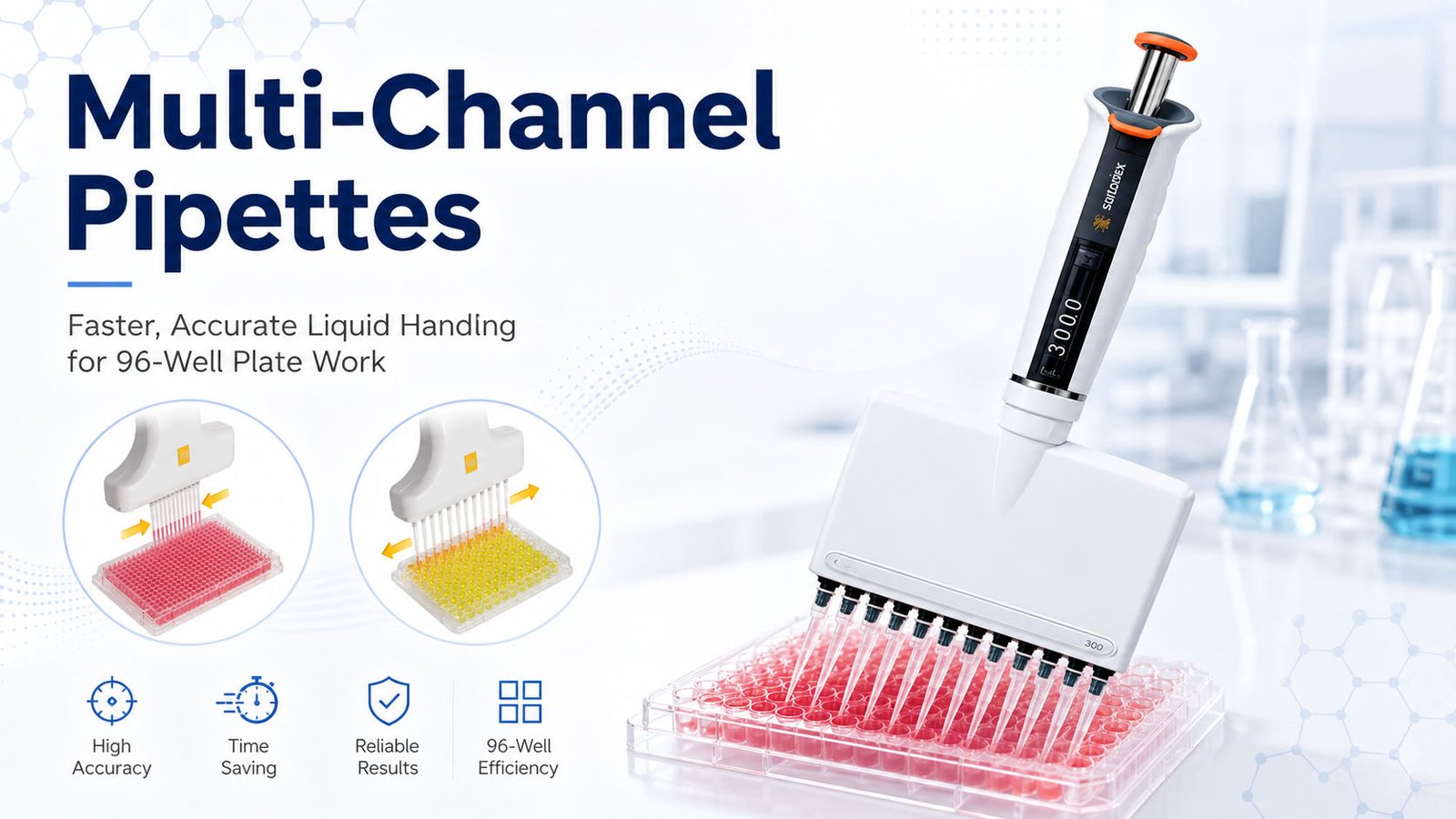
Fixed-volume units reduce setting changes in repetitive work, adjustable units suit varied protocols, and multichannel units speed compatible microplate work. Select the type from the sample layout and daily number of transfers—not from channel count alone. For a 96-well workflow, an 8-channel pipette aligns with a row; a 12-channel pipette aligns with a column.
| Type | Suitable application | Throughput | Advantage | Selection consideration |
|---|---|---|---|---|
| Fixed-volume micropipette | Repeated single-volume transfers | Low to medium | Simple, repeatable setting | Confirm the fixed volume matches the method. |
| Adjustable single-channel | Dilutions, QC prep, research | Low to medium | Flexible across a defined range | Use close to its normal working range; do not force one broad range across all tasks. |
| Electronic pipette | Repetitive dispensing or multi-step protocols | Medium to high | Can reduce repetitive manual operation | Assess battery, programming, service and training needs. |
| 8-channel micropipette | 96-well plates, ELISA, screening | High | Transfers one plate row at a time | Verify channel alignment, tip seal and calibration support. |
| 12-channel micropipette | 96-well plate columns | High | Faster full-plate setup | Confirm plate geometry and operator comfort. |
| Pipette controller | Serological pipettes and cell culture media | Medium | Controlled mL-scale transfers | Choose compatible serological pipettes and a suitable filter. |
| Bottle-top dispenser | Repeated reagent dispensing | Medium | Reduces repeated manual filling | Check chemical compatibility, volume range and cleaning procedure. |
How should you choose the correct volume range?
Use the smallest practical pipette range that comfortably contains the working volume because a 2–20 µL instrument is a more appropriate starting point for a 10 µL transfer than a 100–1000 µL instrument. Build the set around actual method volumes: 0.1–2.5 µL and 0.5–10 µL for very small molecular work; 2–20 µL and 20–200 µL for many PCR, ELISA and assay transfers; and 100–1000 µL for general preparation.
Decision rule: List every transfer volume from the SOP, circle the five most frequent volumes, then choose ranges that cover those values without operating at an extreme. This original procurement decision map prevents a common RFQ error: specifying “one universal micropipette” for a lab that actually needs three or more working ranges.
- Extract transfer volumes, sample matrices and plate/tube formats from the method.
- Choose single-channel, 8-channel or 12-channel operation from the receiving format.
- Match a named tip volume and fit system to each pipette range.
- Define the cleanliness certification required by the workflow.
- Request calibration scope, service path, warranty and delivery terms in the quotation.
Which pipette-tip specification protects PCR, ELISA and QC workflows?
Tip selection should follow the sample and contamination risk. Thermo Fisher’s selection guide associates PCR/qPCR with filtered low-retention tips, DNA/RNA work with certified RNase/DNase-free tips, viscous liquids with wide-bore or low-retention formats, and volatile or hazardous samples with aerosol-barrier protection. These are application prompts, not universal substitutions: always confirm the pipette manufacturer’s recommended fit and the tip’s current documentation.
| Workflow | Tip feature to evaluate | Why it matters | RFQ evidence to request |
|---|---|---|---|
| PCR/qPCR | Filtered, low-retention; specified cleanliness grade | Helps manage aerosol carryover and sample loss. | Lot certificate and stated DNase/RNase/PCR-inhibitor status. |
| DNA/RNA extraction | Certified nuclease-free, filtered where protocol requires | Supports sample-integrity controls. | Manufacturer certificate and compatibility statement. |
| ELISA / 96-well assay | Reliable multichannel fit, racked format | Consistent sealing and handling affect workflow reliability. | Rack format, volume graduation and multichannel compatibility. |
| Viscous liquids | Wide-bore or low-retention, where method permits | Can improve transfer of liquids such as glycerol. | Material and intended-use documentation. |
| Routine QC / teaching lab | Standard polypropylene tip matched to range | Balances fit, availability and cost for non-critical transfers. | Pack quantity, stated fit, batch identification and storage conditions. |
“Universal fit” is not a substitute for checking the actual cone and tip specification. A tip that feels tight can damage the cone; one that seals inconsistently can affect aspiration. When brands such as Eppendorf, Thermo Fisher or Borosil are under consideration, compare the current manufacturer datasheet, not only a reseller description. Do not assume that a tip certification, sterility claim or compatibility statement transfers from one product family to another.
Need a liquid-handling RFQ matched to your lab protocol?
Share the volume ranges, sample type, plate format, required tip cleanliness and delivery city. Scientific Edge can help structure a comparable quotation for instruments and consumables.
WhatsApp requirements Call +91 99901 40888Manual, electronic, single-channel or multichannel: what should a buyer compare?
Manual single-channel pipettes are often the sensible starting point for low-volume, varied work. Electronic and multichannel options become more compelling when repetitive transfers, plate work or operator fatigue are material process risks. A premium instrument is not automatically the better procurement choice if its service model, tips or user training do not fit the laboratory’s operating plan.
For most QC labs running fewer than 20 low-volume transfers per day, a calibrated manual single-channel set with approved tips is usually the smarter spend than an electronic system. Conversely, a diagnostic or molecular lab making repeated plate transfers should quantify time per plate, error-rework risk and operator fatigue before rejecting multichannel equipment on purchase price alone.
What calibration and documentation should regulated labs request?
A calibration certificate is evidence for a stated instrument, method and condition; it is not a blanket promise that any pipette-tip combination will perform identically. ISO 8655:2022 addresses pipette testing and, for regulated environments, laboratories should align calibration intervals and acceptance criteria with their risk assessment, SOPs and applicable quality system.
- Instrument make, model, serial number and volume range.
- Calibration or verification method, test volumes and measured results.
- Traceability information, certificate date and next-due policy.
- Tip or consumable system used for the test, where supplied.
- Service, preventive-maintenance and replacement-part route in India.
Scientific Edge is a Delhi NCR-based laboratory supply and procurement partner serving pharmaceutical, diagnostic, environmental and food-testing labs across India. For a GMP or NABL-facing purchase, put the required documentation in the purchase specification before quote comparison so the commercial and quality teams evaluate the same deliverable.
How can procurement teams compare micropipette quotations fairly?
Compare like-for-like systems: identical volume bands, channel count, tip format, certification needs, calibration scope and service inclusions. A line-item price alone hides the ongoing cost of filter tips, racks, calibration and downtime. The following original RFQ checklist is designed for Scientific Edge buyers and can be copied into an institutional or vendor-empanelment request.
Copy-paste liquid-handling RFQ checklist
| Product needed | Volume / channels | Application | Tip requirement | Documentation | Quantity / city |
|---|---|---|---|---|---|
| Adjustable micropipette | 20–200 µL, single channel | ELISA sample prep | Racked, filtered if method requires | Calibration certificate; datasheet | 3 units / Noida |
Send this requirement on WhatsApp with quantities, delivery location and preferred documentation. Ask for GST-compliant quotation and estimated dispatch terms.
Frequently asked questions about micropipettes and pipette tips
These answers address the selection questions procurement and laboratory teams most often raise: working range, PCR contamination control, confirmed tip fit, calibration planning and the practical case for manual or electronic pipettes. Each answer should be checked against the method, manufacturer documentation and local quality procedures before purchase.
What volume range is best for a 10 µL transfer?
A 2–20 µL or other manufacturer-specified range that comfortably includes 10 µL is generally more appropriate than a 100–1000 µL range. Confirm the method, pipette specification and calibration acceptance criteria before finalising a purchase.
Are filtered pipette tips necessary for PCR?
Filtered, low-retention tips are commonly evaluated for PCR and qPCR because they can help manage aerosol carryover and reduce loss of precious reagents. Follow the assay manufacturer’s instructions and use the certification level required by the workflow.
Can any universal pipette tip fit every micropipette?
No. “Universal” is a supplier claim that must be checked against the specific pipette cone and manufacturer guidance. Confirm fit, sealing and the stated compatible model family before institutional purchase.
How often should a micropipette be calibrated?
Set the interval through risk assessment, use frequency, sample criticality, SOPs and applicable quality requirements. Check performance after impact, leakage, unusual results or a change that could affect the pipette-tip system.
Manual ya electronic micropipette kaunsa lena chahiye?
Low-throughput routine work often suits a calibrated manual unit. Repeated dispensing, plate work or a high number of transfers can justify assessing electronic options alongside service, training and compatible-tip costs.
Best quality pipette tips kahan milega?
Start with the method’s required volume, cleanliness certification, fit and pack format—not a generic “best” label. Ask Scientific Edge or another qualified supplier for current manufacturer documentation, compatibility evidence, batch identification and a GST quotation.
Final selection checklist for Indian laboratory buyers
Buy the pipette and tip as a documented system. Map the SOP’s real volumes, choose channels around the receiving format, match tip properties to sample risk, and obtain calibration and service evidence before placing a bulk order. This prevents a cheap but incompatible consumable purchase from becoming a repeatability problem later.
For related planning, compare Scientific Edge’s electronic pipettes, multichannel models and pipette controllers, browse the wider laboratory equipment portfolio, and use the industry application guidance and COA documentation guide when a purchase needs documented quality evidence. A future liquid-handling pillar should link here with the anchor “micropipette and pipette-tip selection guide.”
Request a comparable micropipette and tip quotation
Send the protocol volume range, expected monthly usage, required documentation and delivery city. We will help turn it into an RFQ that technical and procurement teams can evaluate together.
WhatsApp for a quoteCall salesWhat primary technical references support this guide?
This guide uses ISO 8655-2:2022 for the pipette-system context and manufacturer educational material for application-specific tip and instrument selection. Current product datasheets and validated laboratory procedures take precedence whenever they differ from general guidance.