Analytik Jena multi EA 5100 for Fuel Ethanol Testing in India
Can one elemental analyzer produce every sulfur and chloride result on your distillery’s finished-product test report? Here is how the multi EA 5100 maps to IS 15464—and what to put in your India RFQ.
The purchasing question behind every ethanol QC laboratory
An ethanol plant supplying fuel-grade product to oil marketing companies must report total sulfur and chloride concentrations on every dispatch batch. The question that reaches the procurement desk is straightforward: can one elemental analyzer produce every result on the laboratory's IS 15464 test report?
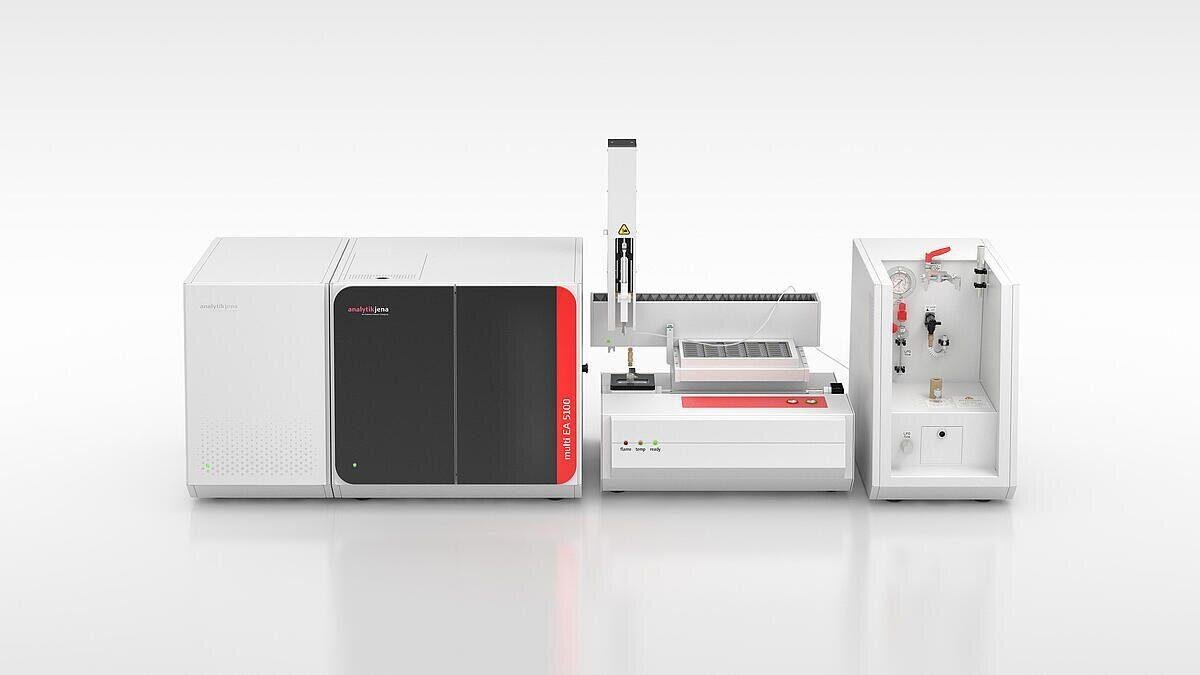
The Analytik Jena multi EA 5100 is a modular C/N/S/Cl elemental analyzer that handles liquid, solid and gaseous samples using high-temperature combustion. For a distillery QC laboratory, the instrument's sulfur module is a strong candidate for total sulfur testing. The chloride question, however, requires a closer look at what your customer specification actually asks for—and that distinction can determine whether you need one instrument or two.
The multi EA 5100 covers total sulfur in fuel ethanol via UV fluorescence (DIN EN 15486 / ASTM D5453). However, its coulometric chlorine module measures total chlorine, whereas IS 15464:2022 specifies inorganic chloride by ion chromatography (ASTM D7319). Confirm your test report rows before ordering.
What IS 15464 requires for sulfur and chloride in fuel ethanol
IS 15464:2022 is the Bureau of Indian Standards specification for anhydrous ethanol used as a blending component in motor gasoline. Under India's E20 Ethanol Blended Petrol Programme, every distillery dispatching fuel ethanol to IOCL, BPCL or HPCL must clear each batch against this standard. The two parameters relevant to elemental analysis are:
| Parameter | IS 15464:2022 limit | Accepted test methods |
|---|---|---|
| Total sulfur | ≤ 10 mg/kg | ASTM D5453, EN 15486, ASTM D7039 |
| Inorganic chloride | ≤ 3.0 mg/kg | ASTM D7319, EN 15492 |
The critical distinction is that IS 15464 specifies inorganic chloride, not total chlorine. The test methods listed—ASTM D7319 and EN 15492—use ion chromatography, a technique that separates and quantifies ionic (inorganic) species directly. This is a different measurement principle from the combustion-based total-chlorine method used by the multi EA 5100's chlorine module.
Understanding this distinction before requesting quotations prevents a common procurement error: assuming that any instrument labelled "sulfur and chlorine analyzer" automatically covers both rows on the IS 15464 test report.
Measuring total sulfur with the multi EA 5100
The multi EA 5100 sulfur module uses ultraviolet fluorescence detection (UVFD). The system injects the ethanol sample into a high-temperature combustion furnace (up to 1,100 °C) in an oxygen-rich atmosphere. Sulfur compounds in the sample oxidise to sulfur dioxide (SO₂). After drying, the SO₂ passes into a UV fluorescence detector, where the intensity of fluorescent light emitted by excited SO₂ molecules is proportional to the total sulfur concentration.
Analytik Jena lists the following standards for the UVFD sulfur module:
- DIN EN 15486 — specifically scoped for ethanol as a fuel-blending component. The standard's validated concentration range is 5–20 mg/kg sulfur.
- ASTM D5453 — covers total sulfur in light hydrocarbons, spark-ignition engine fuel, diesel fuel and engine oil by UV fluorescence. Broadly applicable to liquid fuels including ethanol.
Both methods are accepted under IS 15464:2022 for total sulfur.
Sulfur module — key specifications
| Parameter | Published specification |
|---|---|
| Detection principle | UV fluorescence (UVFD) |
| Relative operating range | Up to 10,000 mg/L |
| Absolute operating range | Up to 200 µg S |
| Limit of detection (LOD), relative | 5 µg/L |
| Limit of detection (LOD), absolute | 0.2 µg S |
| Listed standards for ethanol | DIN EN 15486, ASTM D5453 |
Source: Analytik Jena multi EA 5100 Technical Data Sheet
LOD versus LOQ — a practical distinction
The table above shows the instrument's limit of detection (LOD)—the lowest concentration at which a signal can be reliably distinguished from noise. For reporting purposes, however, the laboratory needs the limit of quantification (LOQ)—the lowest concentration at which a numerical result meets defined accuracy and precision criteria.
As a general convention, the LOQ is often estimated at approximately 3–5 times the LOD, but the achievable LOQ depends on the specific sample matrix, injection volume, calibration and laboratory conditions. If your customer specification requires you to report sulfur at or near the 10 mg/kg limit, the published LOD of 5 µg/L suggests the instrument should be capable—but ask the supplier to confirm the achievable LOQ for your ethanol matrix and method, stated in the same units as your test report.
Can the multi EA 5100 measure inorganic chloride in ethanol?
This is where the wording on your test report determines the answer.
What the chlorine module measures
The multi EA 5100 chlorine module uses micro-coulometric titration. After combustion, hydrogen chloride (HCl) gas produced from chlorine-containing compounds is absorbed into a titration cell, and the chlorine content is determined coulometrically. The manufacturer describes this result as total chlorine and explains that the system detects organically bound chlorine. The instrument's manual states that inorganic halogen compounds may be digested only partially or may remain undetected.
Chlorine module — key specifications
| Parameter | Published specification |
|---|---|
| Detection principle | Micro-coulometric titration |
| Relative operating range | Up to 100,000 mg/L |
| Absolute operating range | Up to 1.00 mg Cl |
| Limit of detection (LOD), relative | 50 µg/L |
| Limit of detection (LOD), absolute | 10 ng Cl |
Source: Analytik Jena multi EA 5100 Technical Data Sheet and Manual
Why this does not satisfy the IS 15464 inorganic chloride requirement
IS 15464:2022 specifies inorganic chloride at ≤ 3.0 mg/kg, tested by ASTM D7319 (direct-injection suppressed ion chromatography) or EN 15492. These ion-chromatography methods specifically separate and quantify the chloride ion (Cl⁻) as a dissolved inorganic species in the ethanol matrix. They do not rely on combustion.
A total-chlorine result from combustion-coulometry cannot be reported as an inorganic chloride concentration. The two measurements answer different analytical questions:
| Question | Technique | Instrument type | IS 15464 parameter |
|---|---|---|---|
| What is the total chlorine content, including organic chlorine? | Combustion + coulometric titration | Elemental analyzer (e.g., multi EA 5100 Cl module) | Not the specified parameter |
| What is the inorganic chloride (Cl⁻) concentration? | Direct-injection ion chromatography | Ion chromatograph (IC) | Inorganic chloride ≤ 3.0 mg/kg |
If your IS 15464 test report has a row for inorganic chloride tested by ASTM D7319, the multi EA 5100's chlorine module alone does not cover that row. You will likely need an ion chromatograph—from manufacturers such as Metrohm, Thermo Fisher (Dionex) or Shimadzu—configured for ASTM D7319. If your report includes both total chlorine and inorganic chloride, include both rows in your RFQ.
What to include in your India RFQ
The Analytik Jena multi EA 5100 price in India depends on the analytical modules selected, the sample-introduction system, autosampler requirements, gas supply, installation scope and ongoing support. A useful quotation should show what it takes to get from instrument delivery to the first reportable sample result that satisfies your customer specification.
| RFQ field | Information to provide | What the supplier should confirm |
|---|---|---|
| Sample type & standard | Anhydrous fuel ethanol per IS 15464:2022 | Suitability of the proposed configuration for the declared matrix and standard |
| Parameters, methods & limits | Total sulfur per EN 15486 or ASTM D5453, ≤ 10 mg/kg; inorganic chloride per ASTM D7319, ≤ 3.0 mg/kg | Proposed detector/module for each parameter, working range and achievable LOQ in your units |
| Routine sample volume | Number of samples per shift or day, batch frequency | Suitable sample-introduction system; whether an autosampler (e.g., MMS with liquids kit) is justified |
| Installation site | City, bench space, electrical supply, compressed-gas availability | Gas grades and purity required, regulators, tubing, ventilation and exhaust requirements |
| Commissioning & training | Timeline, number of operators to be trained | Installation, operator training, initial calibration standards, first consumables kit and warranty |
| Service & support | Expected uptime, preventive maintenance | Service engineer availability near installation city, AMC options, spare-parts lead time |
| Documentation | COA for standards/consumables, IQ/OQ if applicable | What documentation is included, what is available on request, any additional cost |
| Inorganic chloride scope | Whether an IC system is also required; preferred make if any | Proposed IC configuration for ASTM D7319, or confirmation against test-report requirements |
Before placing the order
Ask the supplier for a demonstration using a representative plant sample. Agree in advance on what the demonstration should establish—such as repeatability at or near the 10 mg/kg sulfur reporting level, or recovery of a chloride spike. For a plant commissioning its first elemental analyzer, this also gives the QC team a chance to see routine operation, evaluate sample handling and assess the consumables workflow.
Planning a new ethanol QC laboratory or adding sulfur testing?
Share your sample type, required test methods, reporting limits, daily sample count and installation city. A redacted customer test report is a practical starting point for a configuration review and itemised quotation.
Why ScientificEdge? Strength, Potential & Pan-India Support
ScientificEdge is a Delhi NCR-based B2B supplier and sourcing partner supporting laboratory, filtration, water-treatment and industrial requirements across India, with suitability, documentation and supply terms confirmed for each enquiry.
When a distillery or industrial QC laboratory invests in elemental analysis, the analyzer is only one part of a reliable testing workflow. ScientificEdge helps buyers avoid mismatched specifications and fragmented vendor follow-ups by supporting both the core instrument enquiry and the surrounding laboratory consumables ecosystem.
Priority Regional & Pan-India Ethanol QC Coverage
Coordinated from our Delhi NCR base, ScientificEdge supports fuel ethanol distilleries, petroleum blending terminals, chemical plants and institutional QC laboratories across India's high-growth industrial belts (subject to item-specific logistics, installation scope and service availability):
Direct procurement coordination for corporate R&D centres, commercial testing labs, institutional buyers and industrial QC facilities across the NCR corridor.
Supporting distilleries, pharma/API manufacturing, process-water plants and environmental testing laboratories requiring validated QC instrumentation and consumables.
Serving emerging grain-based ethanol plants, refinery/petrochemical QC near Barauni and regional water/food testing laboratories under E20 expansion.
Pan-India quotation and supply coordination for India's largest sugarcane-ethanol belts, petrochemical blending terminals and industrial R&D clusters.
Share your application details—sample type, required standard, test methods, reporting limits, sample throughput, installation city and any preferred makes—so ScientificEdge can confirm suitable options and prepare a competitive quotation.
Frequently asked questions
Can the Analytik Jena multi EA 5100 measure both sulfur and chloride in fuel ethanol?
What is the difference between total chlorine and inorganic chloride?
What is the sulfur detection limit of the multi EA 5100 for ethanol?
Which standard does IS 15464 accept for total sulfur in fuel ethanol?
What is the validated range of DIN EN 15486 for sulfur in ethanol?
Do I need an autosampler for the multi EA 5100 in an ethanol plant?
How should I compare multi EA 5100 quotations from different suppliers in India?
Take the next step
If your ethanol plant is evaluating elemental analyzers for IS 15464 compliance, send a copy of your finished-product test report (with confidential details removed) to ScientificEdge along with your daily sample count, required methods, reporting limits and installation city.