How to Choose Water Testing Instruments for an ETP or STP Laboratory
Quick answer: Choose water testing instruments for an ETP or STP laboratory by the decision each result must support, then specify the sample matrix, expected range, approved method, instrument format, calibration evidence and recurring consumables. Common capability includes pH, conductivity or total dissolved solids (TDS), dissolved oxygen (DO), turbidity, chemical oxygen demand (COD) and biochemical oxygen demand (BOD). The final list must match the plant's consent conditions and reporting scope.
A low-priced meter can still be the wrong purchase if its range suits treated drinking water but not high-load effluent, or if a replacement probe, digestion vial or calibration standard is difficult to source. This guide gives laboratory managers, plant operators, environment, health and safety (EHS) teams, and procurement officers a defensible way to prepare an Indian institutional request for quotation (RFQ).
What instruments are used to test water quality in an ETP or STP?
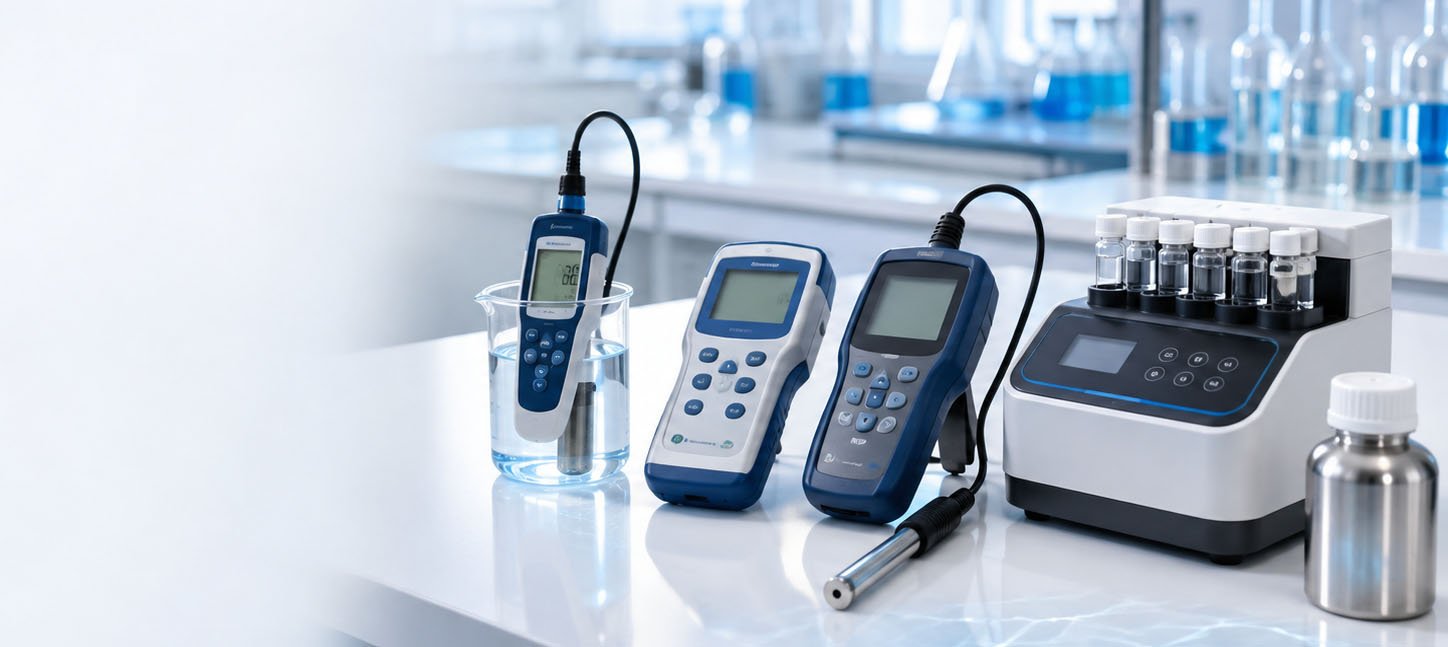
ETP/STP laboratories commonly combine pH, conductivity/TDS, DO and turbidity meters with COD digestion and photometric measurement, BOD incubation and DO determination, and application-specific colorimetric or spectrophotometric tests. Select only the parameters required by the treatment process, reuse target, consent condition and approved reporting method.
The Central Pollution Control Board's water and wastewater laboratory list includes pH, BOD, COD and dissolved oxygen among accredited parameters. It does not create one universal equipment list: industrial effluent, domestic sewage, RO reject and final reuse water need different ranges and supporting tests.
| Decision or parameter | Typical instrument capability | Useful sample point | Specification question before purchase |
|---|---|---|---|
| Acid/alkali condition and neutralisation | Portable, benchtop or online pH meter/analyzer | Influent, equalisation, biological stage, final outlet | What range, resolution, temperature compensation, electrode body and calibration points does the method require? |
| Ionic load and dissolved salts | Conductivity/TDS meter or online analyzer | Feed, process stage, treated water, RO streams | Is the instrument range-matched to low-conductivity product water or high-conductivity effluent? |
| Aeration and biological activity | Optical or membrane-probe DO meter | Aeration basin, BOD workflow, treated outlet | Will the probe be used for spot checks, laboratory bottles or continuous immersion? |
| Clarity and suspended-matter trend | Turbidity meter or online turbidimeter | Clarifier outlet, filtration outlet, final water | What measurement range, vial geometry, calibration standard and stray-light control are required? |
| Oxidisable load | COD digester plus colorimeter or spectrophotometer | Influent, stage-wise sample, final discharge | Which approved COD method, vial range, digestion capacity, blank and reagent system will the laboratory use? |
| Biodegradable organic load | BOD incubator plus DO measurement and supporting glassware | Influent and treated outlet | Which approved method, incubation condition, dilution workflow and DO measurement procedure apply? |
How should the sample point determine the instrument specification?
The same parameter can need different ranges, probes and maintenance plans at the inlet, aeration basin and treated outlet. Start with the sample point and the operational action that follows the result. Influent testing detects shock load; aeration-basin testing controls biology; outlet testing supports discharge or reuse decisions.
Scientific Edge's published water-analyzer workflow identifies expected measurement range as a frequent cause of wrong selection. A useful RFQ therefore separates high and low ends for each stream instead of asking for one generic “water quality analyzer.”
- List each sample point and the action the result controls: dosing, aeration, membrane protection, discharge or reuse.
- Separate compulsory parameters from useful trends; do not buy channels the plant will not maintain.
- Record validated low and high values for each matrix, then identify the approved method and reporting purpose.
- Choose portable, benchtop or online format from location, frequency, operator skill and data needs.
- Price calibration materials, probes, reagents, glassware, spares, warranty, service and training with the instrument.
Should an ETP/STP lab choose portable, benchtop or online analyzers?
Use portable meters when technicians move between plant points, benchtop instruments for controlled laboratory work, and online analyzers when continuous trends or control-system output are operationally necessary. Many plants need a combination: online process monitoring for rapid response and laboratory measurement for method-controlled verification.
| Format | Best fit | Primary advantage | Procurement risk to control |
|---|---|---|---|
| Portable | Multiple tanks, field rounds, grab samples | One technician can check several points | Probe protection, battery life, ingress resistance and field calibration must match plant conditions. |
| Benchtop | Controlled laboratory workflow and documented batches | Stable setup, accessories and data handling | The instrument may not suit wet, dusty or high-temperature plant locations. |
| Online | Continuous trend, alarm or process-control input | Higher measurement frequency without repeated grab samples | Flow, pressure, mounting, cleaning, sample conditioning, output signal and maintenance access can determine success. |
For online analyzers, ScientificEdge's requirement form asks for installation details and output needs because the parameter alone is insufficient. A pH analyzer that cannot send the required 4–20 mA or digital signal, or whose sensor cannot be maintained at the mounting point, may be commercially attractive but operationally unusable.
Need an application-matched instrument shortlist?
Share the plant type, sample points, parameters, expected ranges, format and reporting purpose. Scientific Edge can help structure the requirement before a line-by-line quotation is prepared.
WhatsApp the requirement Call +91 72909 39259Which specifications should procurement compare before asking for price?
Compare measurement range, accuracy, resolution, method compatibility, sensor or reagent system, calibration, data output, environmental rating, consumables and local service before comparing price. For COD, include digestion capacity and vial chemistry; for DO, include probe technology and maintenance; for pH, include the electrode and buffers.
My practical view: a multiparameter instrument is sensible only when its channels match the laboratory's sample matrix and calibration workload. Otherwise, cost shifts into probes and consumables the plant rarely uses.
- Performance: range, resolution, accuracy, repeatability and temperature compensation.
- Method and QC: approved method, buffers, standards, blanks, frequency, traceability and acceptance criteria.
- Recurring supply: electrodes, membranes, reagents, vials, cuvettes and replacement intervals.
- Data: memory, export, audit trail, 4–20 mA, relay or digital protocol as applicable.
- Commercial scope: installation, training, warranty, AMC, calibration support, GST invoice and lead time.
Which Indian locations should this ETP/STP instrument guide serve?
This guide serves PAN-India water-treatment buyers while prioritising Delhi NCR, Himachal-Uttarakhand pharma corridors, Uttar Pradesh-Haryana industrial belts, and Gujarat-Telangana chemical and pharmaceutical clusters. Location changes the sample matrix, service requirement and procurement route; it does not change the need to specify method, range, calibration and consumables.
Scientific Edge coordinates commercial requirements from its Mayur Vihar Phase 3, Delhi office. Current site coverage explicitly highlights Delhi NCR, Noida, Ghaziabad, Baddi, Haridwar and PAN India; the STP/ETP solution page also prioritises Gurugram and Faridabad enquiries. Instrument availability and delivery timing must still be confirmed per model, quantity and destination.
| Region and clusters | Likely buyer context | Instrument-selection emphasis |
|---|---|---|
| Delhi NCR: Delhi, Noida, Greater Noida, Ghaziabad, Sahibabad, Faridabad, Gurugram and IMT Manesar | Hospital and campus STPs, institutional facilities, diagnostics, food, automotive and mixed industrial QC | Portable and benchtop meters for multi-point checks; online analyzers only where continuous trend or control output is required. |
| Baddi, Nalagarh, Barotiwala, Haridwar, Roorkee, Rudrapur and Pantnagar | Pharmaceutical, food, cosmetics and industrial utility or effluent workflows | Method fit, influent/outlet ranges, COD-BOD-DO capability, calibration evidence and recurring reagent/probe planning. |
| Kanpur, Lucknow, Meerut, Panipat and Karnal | Industrial ETPs, textiles, food processing, institutions and environmental laboratories | Matrix-specific range, rugged portable checks, laboratory confirmation and comparable RFQ documentation. |
| Ahmedabad, Vatva, Ankleshwar, Hyderabad, Patancheru and Jeedimetla | Specialty chemical, pharmaceutical and biotech corridors | Influent-to-outlet mapping, COD/pH/conductivity selection, sample conditioning and online output requirements. |
| Pune, Mumbai, Bengaluru, Chennai, Kolkata, Haldia, Paradip and other PAN-India locations | Environmental labs, municipal systems, industrial utilities and project buyers | Confirm service scope, consumable availability and delivery timing per quoted line item rather than by a nationwide assumption. |
For location and contact verification, use the Delhi office and PAN-India coordination details. Buyers in Gurugram and Manesar can also review the verified Gurugram laboratory sourcing page. Separate city landing pages should be created only after the V6 demand, uniqueness and 90-day review gates are met.
What calibration and documentation should the laboratory request?
Request the instrument datasheet, calibration procedure, supplied standards, serial-number traceability, warranty and service scope before issuing the purchase order. For reagent-based methods, also request current safety documentation, lot information and storage conditions. For formal testing, align all evidence with the laboratory's approved method and accreditation scope.
The Bureau of Indian Standards IS 3025 family includes separate methods for water and wastewater parameters; the BIS listing identifies Part 44 for BOD and Part 58 for COD. Check the current edition and laboratory scope instead of copying a generic supplier statement into an SOP. Consent requirements may also differ by industry, state and discharge route.
Scientific Edge is a Delhi NCR-based laboratory supply and procurement partner serving pharmaceutical, diagnostic, environmental and food-testing laboratories across India. The company supplies equipment and sourcing support; it does not itself turn a meter reading into an accredited result or certify regulatory compliance.
How can buyers prepare a comparable ETP/STP instrument RFQ?
A comparable RFQ names the plant, sample points, parameters, ranges, methods, format, quantity, calibration evidence, consumables, outputs and delivery city. This prevents vendors from quoting unlike models under one short description. Copy the matrix below and add the plant's actual consent-condition and SOP references.
Copy-paste water testing instrument RFQ table
Use one row per instrument or parameter. Replace the example text with validated plant information; do not estimate a regulatory range from a sales catalogue.
| Sample point / matrix | Parameter & approved method | Expected range | Format / output | Calibration & consumables | Qty / delivery city |
|---|---|---|---|---|---|
| Example: aeration basin | DO; laboratory SOP reference | Insert validated operating range | Portable; data memory required | Probe type, standards, maintenance kit, certificate scope | 2 units / Noida |
Send the completed matrix by WhatsApp and request an editable checklist if your procurement team needs a lead-magnet version for internal circulation.
Frequently asked questions about ETP/STP water testing instruments
These answers address the selection questions visible in Google India's People Also Ask results and common procurement decisions. They are concise starting points, not replacements for the plant's consent condition, approved SOP, current standard edition, risk assessment or technical review by a competent water-analysis professional.
What instruments are used to test water quality?
Common instruments include pH, conductivity/TDS, DO and turbidity meters; COD digesters with photometric measurement; BOD incubators with DO determination; and colorimeters or spectrophotometers for method-specific chemistry. The correct set depends on source water, wastewater matrix, process objective, reporting method and required range.
How do I choose the right water tester?
Start with the decision the result controls, then define sample point, parameter, expected range, method, frequency, operator and documentation need. Choose portable, benchtop or online format only after those fields are clear. Add the probe, calibration standards, reagents and service scope to the same comparison.
What are the eight common water-quality parameters?
A practical general list is pH, temperature, conductivity/TDS, turbidity, DO, BOD, COD and residual chlorine, but it is not universal. Drinking water, sewage, industrial effluent, boiler water and RO permeate require different parameter sets. Use the applicable standard, consent condition and treatment objective.
What are the typical parameters used for STP water testing?
STP laboratories often monitor pH, BOD, COD, DO, TSS or turbidity, and disinfection-related parameters, with additional nutrients or microbiology where required. Sampling point and frequency matter: influent characterises load, aeration-basin DO supports process control, and outlet testing assesses treatment performance or reuse suitability.
Is a portable or benchtop meter better for wastewater testing?
A portable meter is better for readings at several tanks or remote points; a benchtop instrument is better for controlled laboratory workflow, accessories and repeatable documentation. Many ETP/STP facilities need both. Select by use location and method, not by assuming one format is more accurate in every application.
ETP STP lab ke liye kaunse water testing instruments chahiye?
Common requirement mein pH, conductivity/TDS, DO, turbidity, COD aur BOD capability aati hai. Final list plant ke influent, treatment process, outlet/reuse target, consent conditions aur approved test method se decide honi chahiye. RFQ mein sample point, range, format, calibration aur consumables zaroor likhen.
Does Scientific Edge supply water testing instruments in Delhi NCR and PAN India?
Yes. Scientific Edge coordinates water-analysis requirements from its Delhi office for Delhi NCR and PAN-India buyers. Verified coverage highlighted on its current pages includes Delhi, Noida, Gurugram, Ghaziabad, Faridabad, Baddi and Haridwar. Availability and lead time must be confirmed per instrument, quantity and destination.
What should the final procurement decision include?
The final decision should connect every instrument to a sample point, action, expected range and approved method, then price the complete operating system: probe or reagent, calibration material, accessories, data output, training and service. This produces a usable ETP/STP laboratory specification instead of a disconnected equipment list.
For the commercial next step, compare ScientificEdge's water analyzers and water-quality instruments, review rapid water testing kits for field and plant checks, and connect the measurement plan to STP and ETP system planning. The existing chlorine and hardness test-kit buyer guide supports routine screening decisions.
Request a line-by-line water instrument quotation
Send the completed RFQ matrix with plant type, methods, ranges, quantities, documentation needs and delivery city. Scientific Edge will structure the discussion around comparable technical requirements and applicable commercial paperwork.
WhatsApp for quotation Call sales Discuss a complete water-testing requirementWhich primary technical references support this guide?
This guide uses official CPCB and BIS sources to establish parameter and method-family context. The laboratory should verify current editions, amendments, consent conditions and accreditation scope before formal reporting because a national method family does not by itself define every plant's limit, frequency or approved workflow.