Why Accurate Chlorine and Water Hardness Testing Kits Are Critical for Indian Water Treatment Facilities in 2026
Most water treatment failures in Indian ETP and STP plants trace back to one operational gap — inconsistent field testing of residual chlorine and total hardness. A chlorine test kit reading that drifts by even 0.2 ppm can mean the difference between CPCB-compliant discharge and a regulatory violation notice. Similarly, undetected hardness spikes above 200 ppm CaCO₃ in boiler feed water cause scale deposition that costs lakhs in unplanned shutdowns.
Whether you operate a municipal water supply system, a pharma water purification unit, or an industrial ETP plant, selecting the right water hardness test kit chemicals and chlorine testing reagents directly impacts your compliance record, equipment lifespan, and operational costs. This guide breaks down the selection criteria, kit types, and procurement considerations that Indian water quality professionals need to evaluate in 2026.
Scientific Edge supplies AquaSol and Ion Exchange branded water testing kits across India with full documentation support, GST invoicing, and technical guidance for kit selection matched to your specific water matrix.
What Is a Chlorine Test Kit and How Does It Work?
A chlorine test kit is a portable analytical tool that measures free or total residual chlorine concentration in water samples, typically using DPD (N,N-diethyl-p-phenylenediamine) reagent chemistry with colorimetric comparison. For drinking water applications, BIS 10500:2012 mandates residual chlorine between 0.2–1.0 mg/L at consumer endpoints, making accurate field testing non-negotiable for municipal and institutional water systems.
DPD Colorimetric Method — The Industry Standard
The DPD method remains the most widely adopted technique across Indian water testing laboratories and field operations. When DPD reagent reacts with free chlorine in a water sample, it produces a pink-to-magenta colour whose intensity is directly proportional to the chlorine concentration.
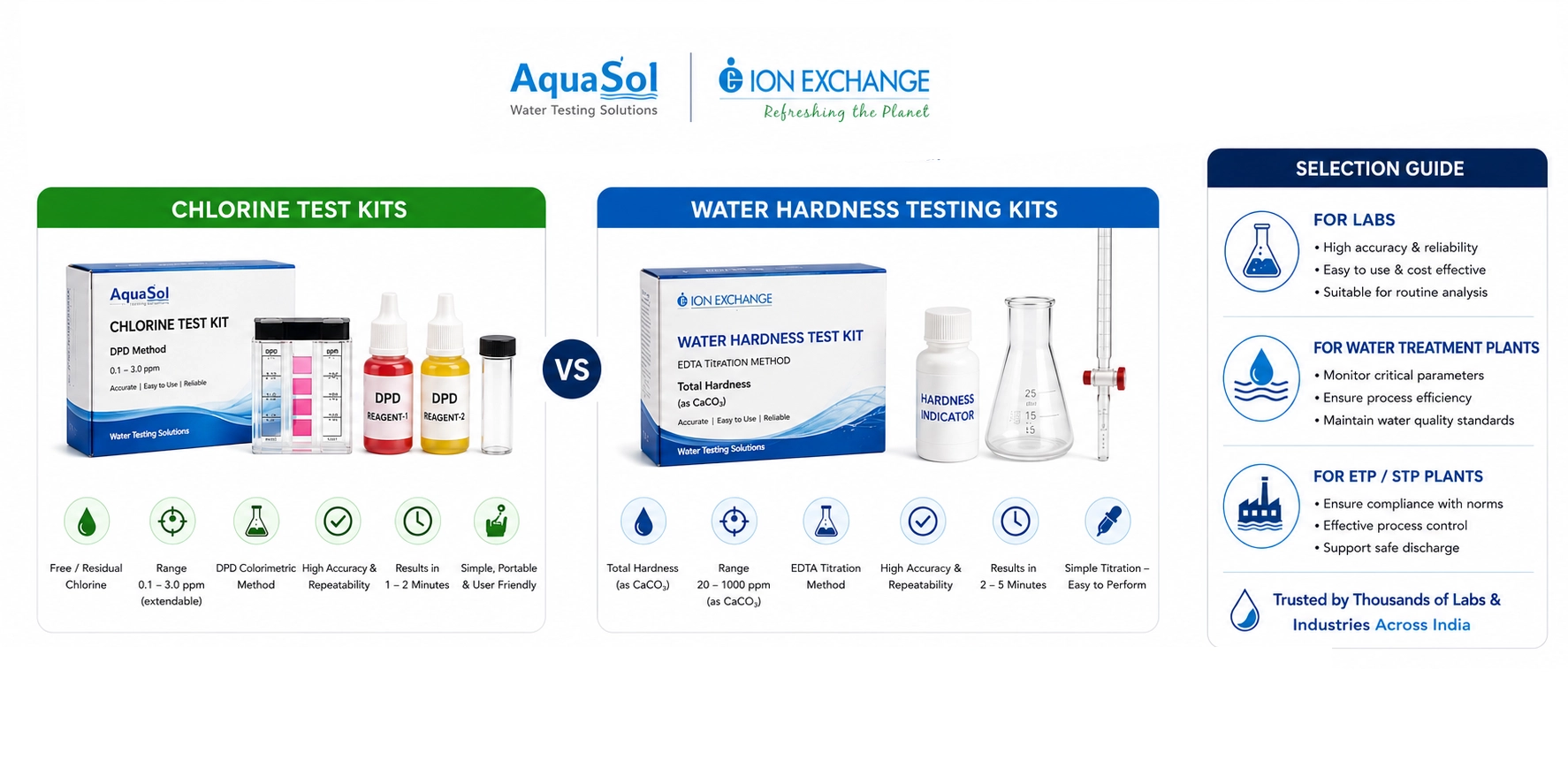
AquaSol's chlorine test kit range (AE-301 to AE-304 series) uses pre-calibrated colour comparators with DPD tablet or liquid reagents, offering measurement ranges from 0.1 to 2.0 ppm for drinking water applications and 0–10 ppm for industrial water treatment monitoring.
Key Specifications to Evaluate
| Parameter | Drinking Water Kit | Industrial/ETP Kit |
|---|---|---|
| Range | 0.1–1.0 ppm or 0–2 ppm | 0–5 ppm or 0–10 ppm |
| Reagent Type | DPD tablets/liquid | DPD or OTO liquid |
| Method | Visual comparator | Comparator or digital |
| Accuracy | ±0.1 ppm | ±0.2 ppm |
| Tests per Kit | 50–200 tests | 100–500 tests |
| Compliance | BIS 10500, WHO | CPCB, SPCB norms |
When to Use OTO vs DPD Reagents
OTO (ortho-tolidine) reagents measure total chlorine and produce a yellow colour change — they are simpler but cannot differentiate between free and combined chlorine. For pharmaceutical water systems and drinking water compliance testing, DPD-based kits are mandatory because regulatory standards specify free residual chlorine measurement.
For swimming pool maintenance and cooling tower monitoring, OTO-based kits offer a cost-effective alternative where total chlorine measurement is acceptable.
What Are Water Hardness Test Kit Chemicals and Why Do They Matter?
Water hardness test kit chemicals are titration-grade reagents — primarily EDTA (ethylenediaminetetraacetic acid) solutions and EBT (Eriochrome Black T) indicator — used to determine total hardness as CaCO₃ in water samples through complexometric titration. For boiler feed water, BIS 3589 recommends hardness below 2 ppm CaCO₃, while cooling tower makeup water typically requires monitoring at 50–500 ppm ranges.
EDTA Titration — How Hardness Kits Work
- Collect sample — Measure a fixed volume (typically 50 mL) of water in the provided sample bottle
- Add buffer — Add ammonia buffer solution to raise pH to 10.0 ± 0.1
- Add indicator — Add EBT indicator; sample turns wine-red if hardness is present
- Titrate with EDTA — Add EDTA solution drop-by-drop until colour changes from wine-red to blue
- Calculate — Each drop equals a fixed ppm CaCO₃ value (typically 10 or 20 ppm per drop depending on kit)
AquaSol Water Hardness Test Kit Range
AquaSol (manufactured by Rakiro Biotech Systems) offers multiple hardness testing configurations:
| Kit Model | Range | Drop Factor | Application |
|---|---|---|---|
| AE-104 | 0–500 ppm | 10 ppm/drop | General water testing |
| AE-105 | 0–200 ppm | 5 ppm/drop | Softener outlet monitoring |
| AE-106 | 0–1000 ppm | 20 ppm/drop | Industrial raw water |
Each kit includes EDTA titrant, buffer solution, EBT indicator, sample bottle, and a dropper assembly — everything needed for 50–100 field tests without laboratory equipment.
How Does the Ion Exchange Water Hardness Testing Kit Compare?
The Ion Exchange (INDION EASYTEST) water hardness testing kit ion exchange uses the same EDTA complexometric principle but is specifically designed for monitoring softener and demineraliser performance in industrial water treatment plants. INDION kits typically offer 0–500 ppm range with a 10 ppm per drop resolution, and include a robust carry case suitable for daily field rounds in boiler houses and cooling tower installations.
AquaSol vs Ion Exchange — Head-to-Head Comparison
| Feature | AquaSol Hardness Kit | Ion Exchange (INDION) Kit |
|---|---|---|
| Range Options | 0–200, 0–500, 0–1000 ppm | 0–500, 0–1000 ppm |
| Drop Resolution | 5, 10, or 20 ppm/drop | 10 or 20 ppm/drop |
| Reagent Shelf Life | 12–18 months | 12 months |
| Refill Availability | Widely available | Through INDION dealers |
| Best For | Lab + field use, multiple ranges | Industrial plant monitoring |
| Price Segment | Competitive | Premium |
| Documentation | COA available | Standard documentation |
Which Kit Should You Choose?
For water treatment plants monitoring softener output where you need to confirm near-zero hardness at the resin bed outlet, the AquaSol AE-105 (0–200 ppm, 5 ppm resolution) provides the sensitivity needed. For raw water intake monitoring at industrial facilities where hardness can exceed 500 ppm, the AquaSol AE-106 or INDION equivalent at 0–1000 ppm range is more practical.
📞 Need help selecting the right chlorine or water hardness test kit for your facility? Call Scientific Edge or WhatsApp your water quality parameters — our technical team will recommend the exact kit configuration, reagent quantities, and replacement schedule for your testing frequency. Get a quotation within 2 hours.
Top 5 Criteria for Selecting Water Testing Kits in Indian Industrial Facilities
Procurement officers at water treatment plants and environmental labs often default to the lowest-price kit without evaluating total cost of ownership. Here are the five factors that experienced plant engineers actually prioritize:
- Measurement range alignment — Match the kit range to your actual water matrix. A 0–10 ppm chlorine kit is wasteful for drinking water testing (0–1 ppm range needed), and a 0–200 ppm hardness kit won't read raw water at 600 ppm CaCO₃.
- Reagent refill cost and availability — The initial kit cost is a fraction of annual reagent consumption. AquaSol reagent refills are available PAN India through authorized distributors like Scientific Edge, ensuring you don't face stockouts during monsoon season when testing frequency doubles.
- Tests-per-kit economics — Calculate the cost-per-test, not cost-per-kit. A kit costing ₹800 that delivers 100 tests (₹8/test) may be more economical than a ₹500 kit delivering only 50 tests (₹10/test).
- Regulatory compliance mapping — Ensure the kit method aligns with your regulatory framework: BIS standards for drinking water, CPCB norms for effluent discharge, and pharmacopeial methods for pharma water systems.
- Documentation and traceability — For NABL-accredited labs and GMP-compliant pharma facilities, procure kits with COA (Certificate of Analysis) and batch traceability. Scientific Edge provides full documentation support with every AquaSol kit supplied.
Which Industries Need Chlorine and Water Hardness Test Kits in India?
Chlorine and water hardness testing cuts across virtually every industry that processes, treats, or consumes water — but the testing requirements, frequencies, and regulatory frameworks differ significantly by sector.
Water Treatment and ETP/STP Plants
Every effluent treatment plant and sewage treatment plant in India requires daily chlorine residual testing at the disinfection stage and hardness monitoring at the softener outlet. CPCB discharge norms mandate treated effluent parameters within prescribed limits — and onsite testing with portable kits provides the rapid turnaround needed for process adjustments between shifts.
Pharmaceutical Manufacturing
USP purified water and WFI (Water for Injection) systems require feed water quality monitoring including hardness testing at the RO pre-treatment stage. Chlorine in municipal feed water must be monitored and removed before the RO membrane to prevent oxidative damage — making a reliable chlorine test kit an essential quality checkpoint.
Food and Beverage Processing
FSSAI-regulated food processing units must verify rinse water chlorination levels at CIP (Clean-in-Place) stations. Hardness monitoring ensures that process water doesn't introduce scale in heat exchangers and boilers, which directly affects production efficiency and product quality.
Municipal Water Supply
Public health engineers and water supply departments use chlorine test kits at multiple points — treatment plant outlet, distribution network checkpoints, and consumer endpoints — to verify disinfection efficacy across the supply chain.
Cooling Towers and Boiler Operations
Industrial facilities running cooling towers and boilers across manufacturing hubs in Noida, Ghaziabad, Sahibabad Industrial Area, Baddi-Nalagarh pharma belt, and Haridwar-Roorkee corridor rely on daily hardness testing to prevent scale formation and weekly chlorine testing in cooling tower circuits to control biological growth.
How to Procure AquaSol and Ion Exchange Test Kits Through Scientific Edge
As an authorized distributor of AquaSol water testing kits, Scientific Edge provides the complete range of chlorine test kits, water hardness test kits, and multi-parameter field testing kits with institutional pricing, GST invoicing, and PAN India delivery.
What You Get With Scientific Edge
- Complete AquaSol test kit range — Chlorine (free & total), hardness, pH, alkalinity, iron, silica, phosphate, and dissolved oxygen kits
- Ion Exchange (INDION) testing kits — Industrial water monitoring solutions
- Reagent refill supply — Never run out of testing chemicals with scheduled refill dispatch
- COA and batch documentation — Full traceability for NABL and GMP compliance
- Technical guidance — Kit selection matched to your water matrix and testing frequency
- Bulk and institutional pricing — Competitive quotations for rate contracts and annual procurement
- Same-day dispatch in Delhi NCR, next-day delivery across North India
Scientific Edge supplies AquaSol water testing kits across India with COA documentation, GST invoicing, and technical support for kit selection — serving pharmaceutical plants, water treatment facilities, environmental labs, and industrial QC departments from Delhi NCR.
Frequently Asked Questions
Q1: What is the difference between a free chlorine test kit and a total chlorine test kit?
A free chlorine test kit measures only the active disinfecting form of chlorine (hypochlorous acid and hypochlorite ion) using DPD reagent, while a total chlorine kit measures both free and combined chlorine (chloramines). For drinking water compliance per BIS 10500, free chlorine measurement is required. AquaSol offers both variants in their test kit range.
Q2: How often should water hardness be tested in a boiler water treatment plant?
Boiler feed water hardness should be tested at least twice per shift — once at the softener outlet and once at the boiler feed tank. For high-pressure boilers operating above 30 kg/cm², continuous monitoring or hourly testing is recommended to prevent scale deposition that can cause tube failures.
Q3: Can AquaSol water hardness test kit chemicals be purchased separately as refills?
Yes, AquaSol provides reagent refill packs including EDTA titrant, buffer solution, and EBT indicator separately. Scientific Edge stocks refill chemicals and can set up scheduled dispatch for facilities with predictable consumption rates. This significantly reduces per-test costs compared to purchasing complete kits each time.
Q4: Which water hardness test kit is better — AquaSol or Ion Exchange?
Both AquaSol and Ion Exchange (INDION) kits use the EDTA titration method and deliver reliable results. AquaSol kits offer more range options (0–200, 0–500, 0–1000 ppm) and wider refill availability, while INDION kits are preferred in plants already using Ion Exchange water treatment equipment due to brand standardisation.
Q5: What is the shelf life of chlorine test kit reagents?
DPD reagent tablets typically have a shelf life of 18–24 months when stored in cool, dry conditions away from direct sunlight. Liquid DPD reagents have shorter shelf life (12–18 months). Always check the expiry date before use, as degraded reagents produce faded colour development leading to under-reading of actual chlorine levels.
Q6: Where can I buy a chlorine test kit for drinking water testing in India?
You can procure certified chlorine test kits from Scientific Edge, an authorized distributor of AquaSol water testing kits. Contact for same-day dispatch in Delhi NCR and next-day delivery across India with GST invoice and COA documentation.
Q7: Lab mein water hardness test kit kaise use karte hain?
Water hardness test kit use karna simple hai — 50 mL water sample lein, buffer solution add karein, EBT indicator daalein (colour wine-red hoga), phir EDTA solution drop-by-drop add karein jab tak colour blue na ho jaaye. Har drop ka ek fixed ppm value hota hai — drops count karke hardness calculate karein. AquaSol kit ke saath detailed Hindi instructions available hain.
🔬 Ready to standardise your water testing operations with certified AquaSol chlorine test kits and water hardness testing kits? Call Scientific Edge for grade-specific recommendations, reagent refill scheduling, bulk pricing with GST invoice, and COA documentation support. Or WhatsApp your complete testing kit requirement list for a competitive quotation within 2 hours. Scientific Edge — your trusted water testing kit supplier across India.